Transport for lab specimens: how to package, label and hand off clinical specimens
To transport a lab specimen safely, use triple packaging: a tightly capped, labeled primary receptacle; a leak-proof secondary biohazard bag with enough absorbent for all the liquid (requisition in the separate rear pocket); and rigid outer packaging marked as the regulations require (UN3373 for Category B).
Updated 2026-10-31 · General information, not medical advice
Why specimen packaging matters
A lab result is only as good as the specimen that reaches the analyzer. Between the draw chair and the lab bench, a tube can be dropped, warmed in a hot car, frozen against an ice pack, separated from its paperwork, or left in a lockbox past its stability window. Most of those failures are packaging and handoff problems, not lab problems. When they happen, the patient gets redrawn, the result is delayed, or — worst case — a specimen that cannot be collected again is lost.
Good packaging does three jobs at once. It protects the people who handle the package (couriers, receiving staff, and the public) from exposure to blood and body fluids. It protects the specimen itself from leakage, breakage, contamination and temperature excursions. And it keeps the specimen tied to the right patient and the right order, so the lab can accession it without a phone call. The steps below follow the same logic used by U.S. DOT rules for Category B specimens (49 CFR 173.199), CDC shipping guidance, and the published packaging instructions of the large national laboratories.
This guide is written for physician offices, clinics, home-draw and mobile phlebotomy teams, surgery centers, and anyone who prepares specimens for pickup. It covers the general method; the receiving lab's test directory always has the final word on container type, volume, temperature and stability for a specific test.
The triple-packaging system at a glance
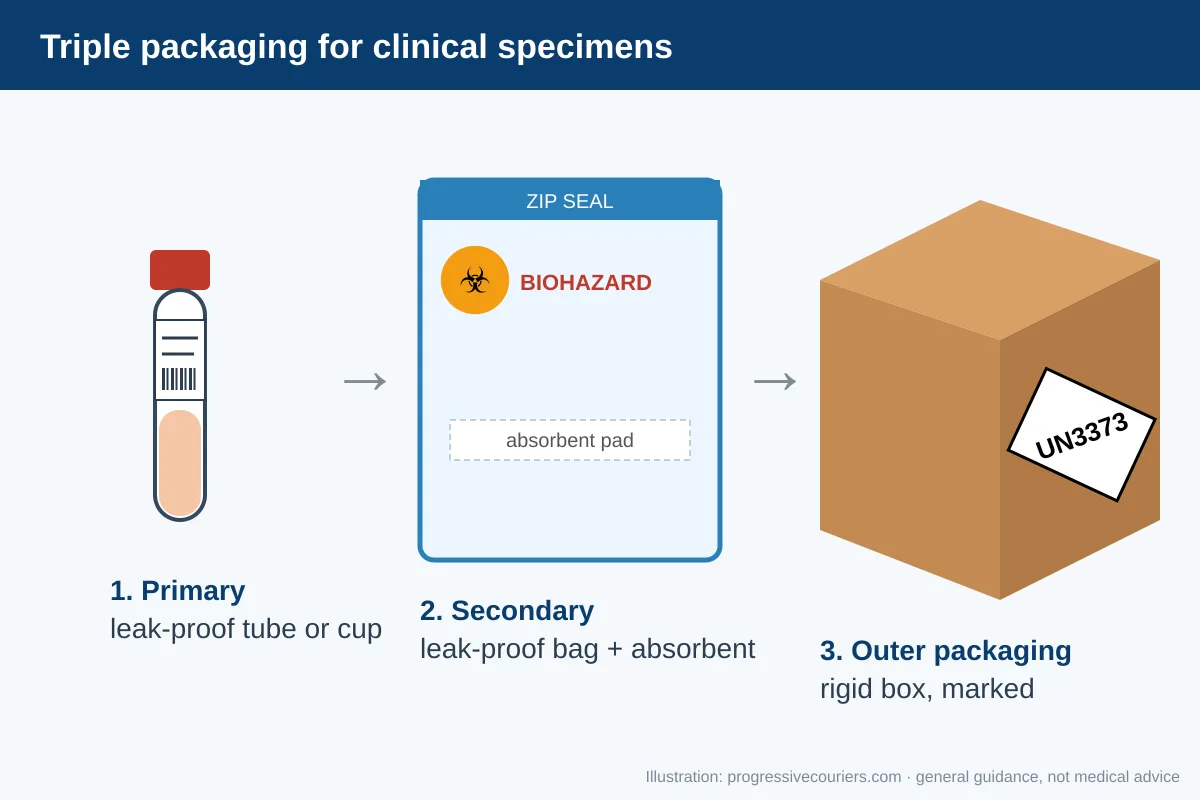
Almost every specimen transport standard is built on the same three layers. The primary receptacle is the tube, cup, swab transport or vial that touches the specimen. The secondary packaging is a leak-proof container — usually a zip-seal biohazard bag — that holds one or more primary receptacles plus absorbent material. The outer packaging is a rigid box, cooler or tote that protects everything from crushing, puncture and temperature swings, and carries any required markings.
Federal rules for Category B specimens describe these layers directly: a leak-proof primary receptacle, leak-proof secondary packaging, and an outer packaging of adequate strength with at least one surface measuring at least 100 mm by 100 mm. For liquids, absorbent material must sit between the primary receptacle and the secondary packaging in a quantity sufficient to absorb the entire contents of all primary receptacles. Multiple fragile primary receptacles in a single secondary package must be wrapped or separated so they cannot touch each other.
Even for short local courier runs, when the specimen never touches an airplane, using all three layers is the simplest way to stay consistent, keep drivers safe and avoid rejected specimens.
Step 1: Prepare the primary receptacle
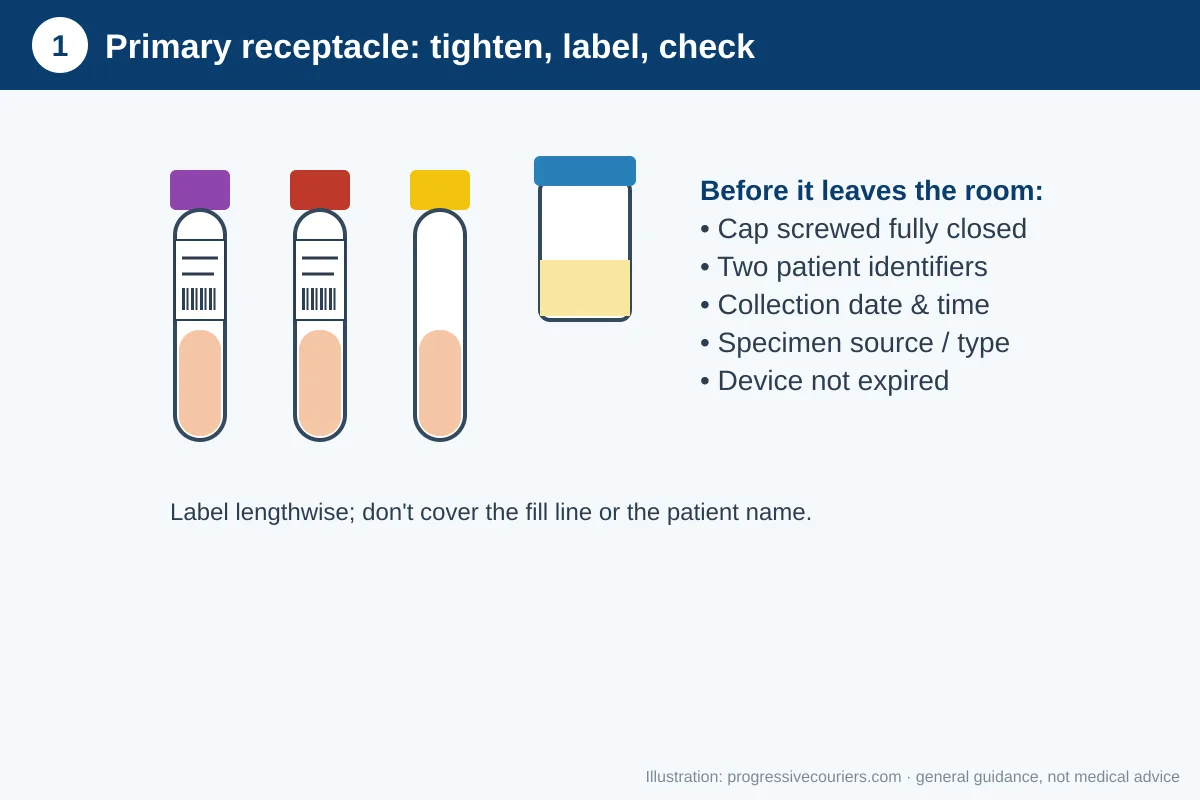
Start with the right container for the test. The lab's test directory lists the tube type (for example serum separator, EDTA, sodium citrate, lithium heparin), sterile cup, transport medium or fixative, plus the minimum volume. Check the expiration date printed on the tube or transport device — several labs state that specimens collected in expired devices or media may be rejected.
Tighten every cap and lid fully. Screw-cap transport tubes should be closed until they stop; push caps must be fully seated. Labs that accept frozen aliquots generally require plastic screw-cap transfer tubes, because glass can crack when frozen and push caps can pop off. Leave headspace in any tube that will be frozen so the liquid can expand.
Label at the point of collection, in front of the patient. At minimum, use two patient identifiers (typically full name plus date of birth or medical record number), the collection date and time, and the specimen source or type when it is not obvious (for example "urine, clean catch" or "wound, left heel"). Apply the label lengthwise, keep it smooth, and do not cover the fill line or any handwritten patient name. Use a permanent marker for anything handwritten; water-based ink can run with condensation or freezing.
For timed or serial collections (tolerance tests, stimulation tests), label each container with the time or sequence and keep the series together.
Step 2: Complete the requisition and use the rear pocket
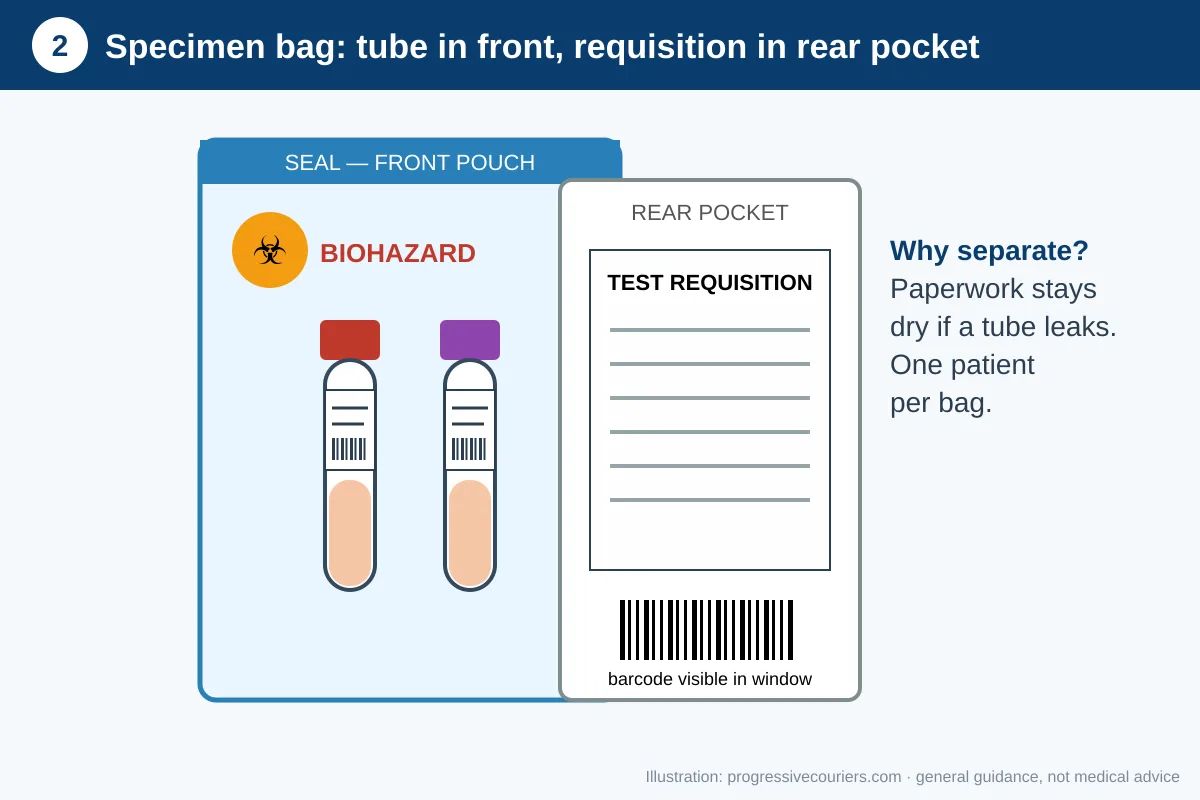
Every specimen needs an order: a paper requisition, a printed electronic order or a manifest, depending on the lab. Make sure the patient demographics on the paperwork match the tube label exactly. A mismatch in name spelling or date of birth is one of the most common reasons a specimen is held or rejected.
Standard two-pouch specimen bags are designed so that paperwork never shares space with the specimen. The specimens go into the sealable front pouch; the folded requisition goes into the separate rear (outer) pocket. Many labs ask you to fold the requisition with the patient name and barcode facing out so the barcode can be scanned through the bag. If a tube leaks, the requisition stays dry and readable.
Use one patient per bag unless the lab explicitly says otherwise, and seal the front pouch completely. Do not staple through the bag or tape over the bag's own barcode or seal.
Step 3: Secondary packaging — leak-proof biohazard bag with absorbent
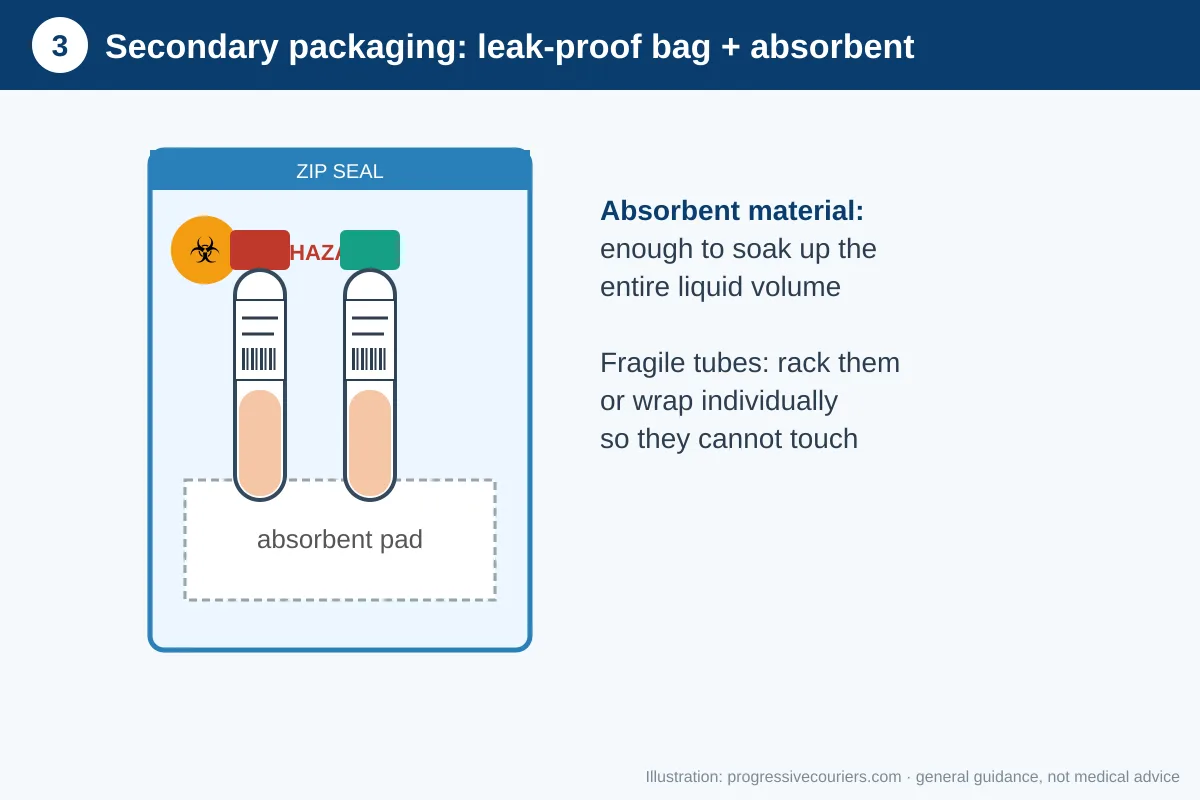
The secondary package is what keeps a broken tube from becoming an exposure incident. Use a leak-proof bag or container marked with the biohazard symbol where the lab or your exposure control plan requires it. Place an absorbent pad or sheet inside, sized for the total liquid volume of everything in the bag; a single urine cup needs far more absorbent than two small tubes.
If you are sending several fragile tubes together, keep them from knocking into each other: use a tube rack, a foam insert, individual sleeves, or wrap each tube separately. Some national labs specify tube racks that fit inside their temperature-coded bags for exactly this reason.
Squeeze out excess air before sealing so the bag does not balloon in heat or at altitude. Check the seal along its full length.
Step 4: Outer packaging and labeling
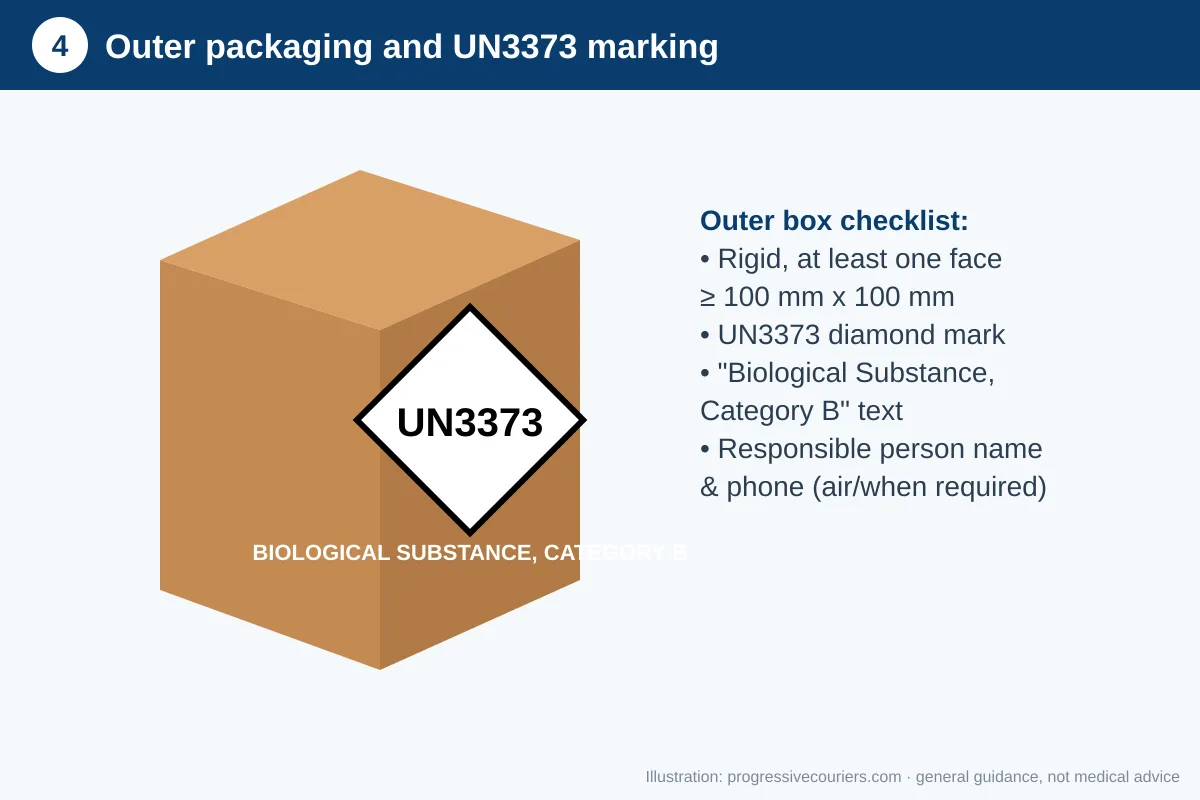
The outer layer carries the weight of the trip. For ground courier routes this is often a hard-sided cooler or rigid tote; for shipments by common carrier or air it is a rigid box or an insulated shipper inside a corrugated box. Whatever you use, it should close securely, survive a drop, and keep bags from sliding around.
When a specimen is shipped as a Category B infectious substance, the outer package must show the UN3373 diamond mark and the words "Biological Substance, Category B" next to it. The mark is a square set at 45 degrees with minimum dimensions defined in the rules. For air transport, the name and phone number of a person responsible for the shipment must be on the package or air waybill. If dry ice is used, add the Class 9 label, "UN1845" or "Dry ice," and the net weight of dry ice in kilograms.
Specimens that a medical professional has judged to have only minimal likelihood of containing pathogens may be shipped as "Exempt human specimen," which still requires triple packaging but not the UN3373 mark. That judgment belongs to the clinician and the lab, not the courier.
Add orientation arrows when the inner containers must stay upright, and a temperature label ("Refrigerate," "Keep frozen," "Room temperature") so every handler knows what is inside without opening the box.
Step 5: Temperature — ambient, refrigerated and frozen
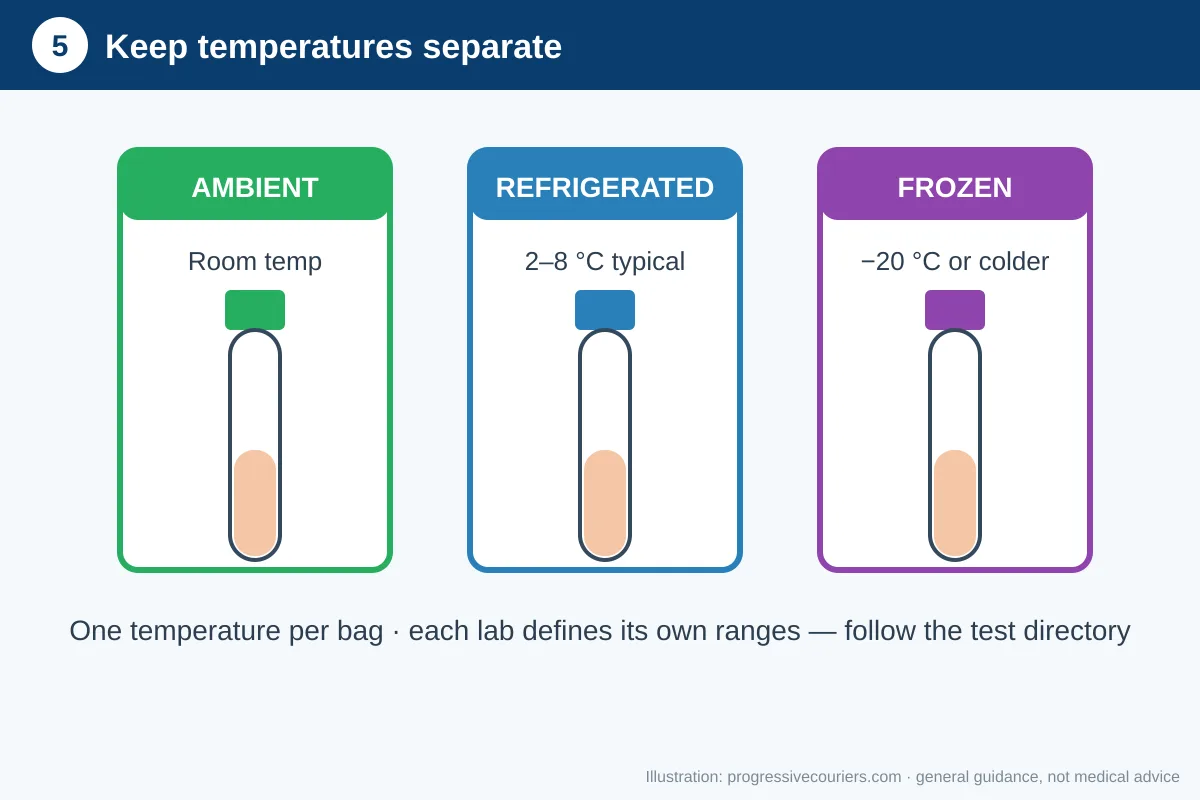
Most clinical specimens travel in one of three temperature classes. Each lab publishes its own definitions, so always use the receiving lab's numbers. For example, Labcorp publishes room temperature as 10.1–40.0 °C, refrigerated as 1.0–10.0 °C and frozen as −1.0 to −80.0 °C, while other labs define refrigerated as 2–8 °C. The practical rule is the same everywhere: one temperature per bag, and keep different temperatures physically separated in the transport container.
Ambient (room temperature) specimens still need protection from heat. In Phoenix summers, a car interior or an outdoor lockbox can climb far above any "room temperature" range within minutes. Use insulated containers and, where the lab recommends it, a conditioned pack to moderate the temperature inside a lockbox. In cold snaps, protect ambient specimens from freezing as well.
Some specimens must not be refrigerated at all (certain cultures and cytology media, for example) and some must be protected from light (amber tubes or foil wrap). Read the test directory entry rather than assuming.
Step 6: Refrigerated transport with gel packs
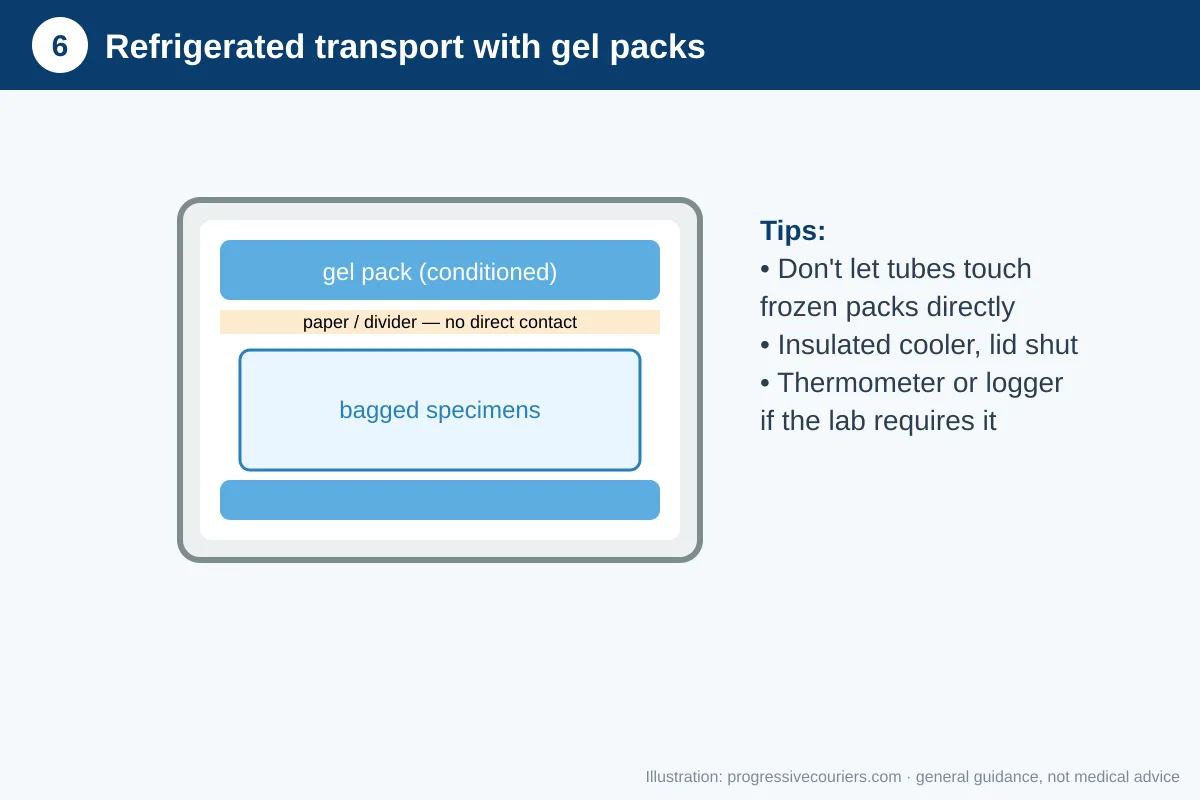
Refrigerated specimens travel with gel packs or cool packs that have been conditioned for the lab's required time. Labs differ on preparation — some ask for packs frozen solid, others for refrigerated packs — so follow the instructions that come with the lab's shipper or courier kit.
Never let a refrigerated tube sit directly against a frozen pack; it can freeze, hemolyze or crack. A sheet of paper, cardboard divider or bubble wrap between the pack and the specimen bags is enough. Keep the cooler closed between stops and limit how long it sits in direct sun.
For longer routes or temperature-sensitive tests, a min/max thermometer or a data logger gives you documentation if a result is ever questioned.
Step 7: Frozen specimens and dry ice basics
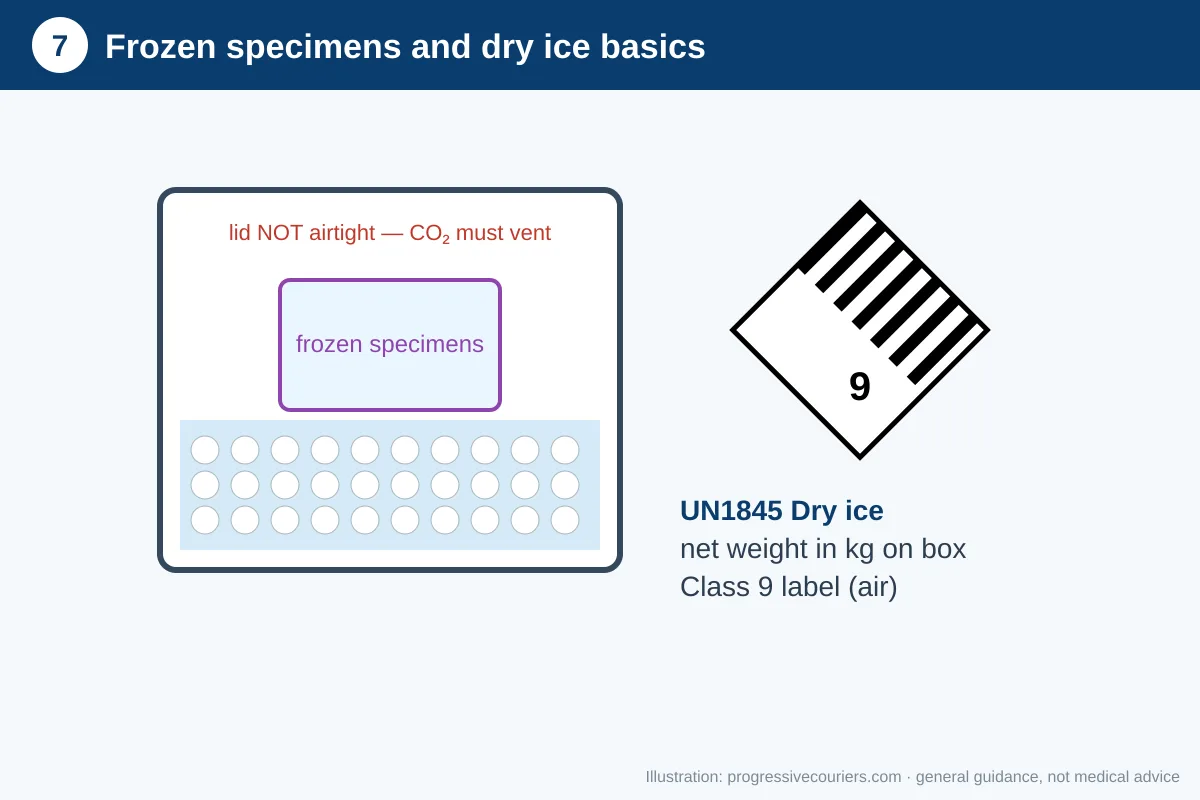
Frozen specimens should be frozen in the correct plastic aliquot tube before pickup and kept frozen without interruption. Thawed-and-refrozen specimens may be unusable. Many labs require a separate bag and a separate requisition (or copy) for frozen specimens, and ask you to tell the courier at pickup that frozen material is waiting.
For short local runs, frozen specimens are commonly carried in a dedicated frozen keeper or with frozen packs designed to hold, not create, frozen conditions. For longer trips and shipments, dry ice (solid carbon dioxide, about −78.5 °C) is used. Dry ice must be able to vent: never seal it in an airtight container or tightly sealed bag, because the expanding gas can rupture the package. Pellets are easier to pack around specimens than blocks; place dry ice so the specimens remain surrounded as it sublimates.
Dry ice is regulated for transport. Air shipments require the Class 9 hazard label, UN1845 identification and the net weight of dry ice on the package, and carriers set their own limits. Handle it with insulated gloves and keep vehicles ventilated. If you do not ship dry ice regularly, follow your lab's shipping kit instructions or ask the lab before improvising.
UN3373 Category B vs. Category A: an overview
U.S. DOT and international air rules divide infectious substances into categories. Category A (UN2814 for substances affecting humans, UN2900 for animals only) covers material capable of causing permanent disability or life-threatening or fatal disease in otherwise healthy people or animals when exposure occurs. Category A packaging is UN-specification packaging with additional testing, shipper's declarations, and specially trained shippers.
Category B (UN3373, "Biological Substance, Category B") covers infectious substances that do not meet the Category A criteria. Most routine diagnostic specimens that are regulated at all — blood, urine, swabs and tissue sent for diagnosis or investigation — fall here. Category B packaging must meet the requirements of 49 CFR 173.199 (triple packaging, absorbent, drop-test-capable outer package, UN3373 marking).
Exempt human specimens are those for which there is minimal likelihood that pathogens are present, based on professional judgment; they still need triple packaging and the words "Exempt human specimen." Regulated medical waste is a separate classification and is not covered in this guide.
Progressive Couriers transports ordinary clinical specimens, including Category B and exempt specimens, on local routes. We do not accept Category A infectious substances. If you are unsure how a specimen is classified, ask the ordering lab before the pickup is scheduled.
Step 8: 95 kPa bags and air transport
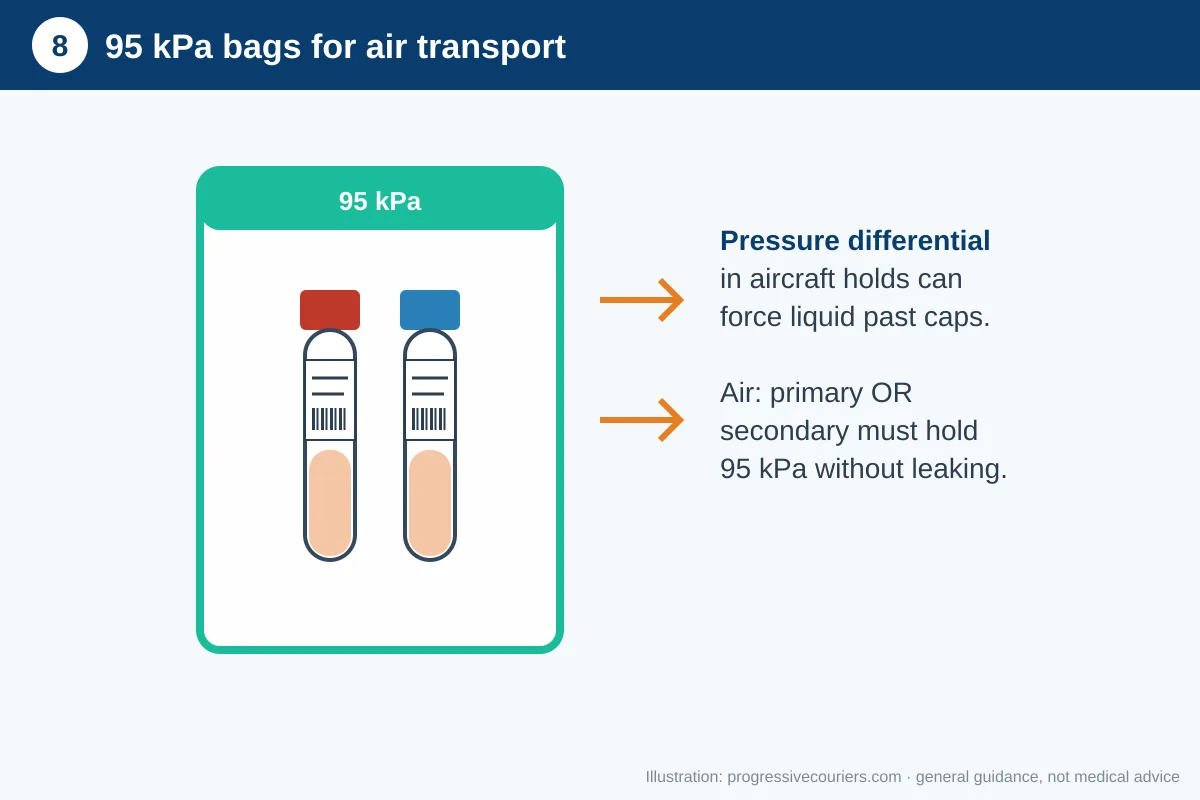
When liquid specimens fly as Category B, either the primary receptacle or the secondary packaging must be able to withstand, without leakage, an internal pressure producing a pressure differential of not less than 95 kPa. The reason is simple physics: pressure changes in an aircraft hold can force liquid past a cap that is perfectly tight on the ground.
95 kPa-rated bags and canisters are labeled by their manufacturers and are sold by the specimen-packaging suppliers listed on our resources page. Some labs supply 95 kPa-validated tubes or bags to their clients. For ground-only transport, the 95 kPa requirement generally does not apply, but some labs choose to use pressure-rated bags for everything to keep one process.
If a specimen will travel by air at any point — for example a local courier hands it to a lab's air network — package it to the air standard from the start.
Step 9: Chain of custody
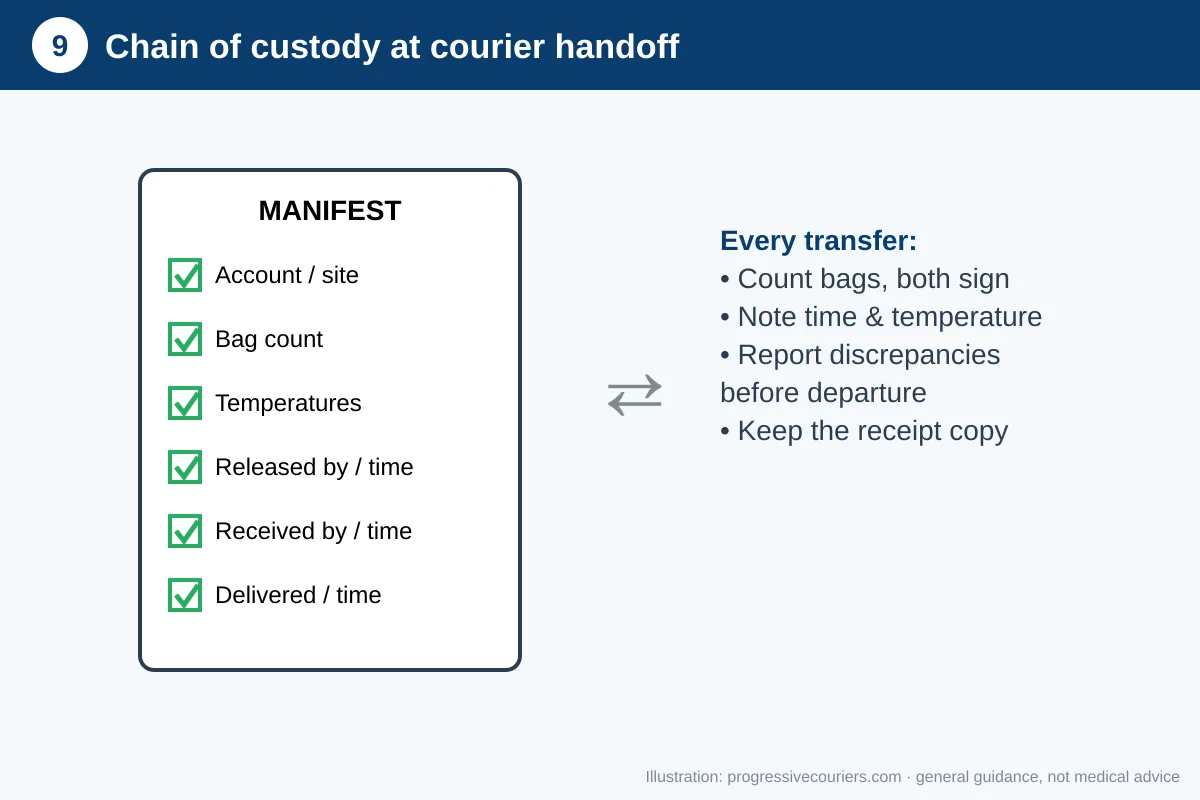
Chain of custody is the record of who had the specimen and when. For routine clinical testing it is usually a manifest or pickup log: the number of bags, temperatures, time released, the courier's name or ID, and time delivered. For forensic or legal testing (drug testing, paternity, some toxicology), formal chain-of-custody forms with tamper-evident seals are required and must be signed at every transfer.
Whatever the format, count the bags with the courier at pickup and write down the count. Many lab bags include a tear-off receipt or barcode for exactly this purpose. Report a missing or extra bag before the driver leaves, not after the results do not show up.
Electronic tracking with timestamps and proof of delivery makes this easier, but it does not replace an accurate count and correct paperwork inside the bag.
Labeling checklist
On the primary receptacle: two patient identifiers, collection date and time, specimen source or type, and collector initials or ID where the lab requires it. On the bag: the patient requisition visible in the rear pocket, any temperature or "STAT" sticker the lab provides, and the bag's own barcode unobstructed. On the outer container: temperature labels, orientation arrows if needed, the UN3373 mark for Category B shipments, "Exempt human specimen" for exempt shipments, Class 9 and UN1845 with net weight when dry ice is used, and the shipper and recipient contact information required for the mode of transport.
Irreplaceable specimens — spinal fluid, tissue from a procedure, bone marrow — deserve an extra flag. Some labs supply special bags or labels for them; at minimum, tell the courier and call the lab so receiving staff are expecting the package.
Timing and specimen stability
Every analyte has a stability window — the time it remains reliable at a given temperature. Glucose drops in unspun blood, potassium rises as cells leak, some coagulation tests must be processed within hours, and many microbiology specimens should reach the lab as soon as possible. The lab's test directory lists stability by temperature; plan the pickup schedule around the shortest window in the batch.
Centrifuge and separate serum or plasma when the test calls for it, and do so within the time the lab specifies. Note the collection time accurately, because the lab calculates stability from it.
For STAT tests, call the lab or use the lab's STAT process, mark the bag clearly, and arrange a direct pickup rather than waiting for the next scheduled route. In the Phoenix metro and the Austin area, our STAT specimen service is built for exactly this situation.
Step 10: Courier handoff checklist
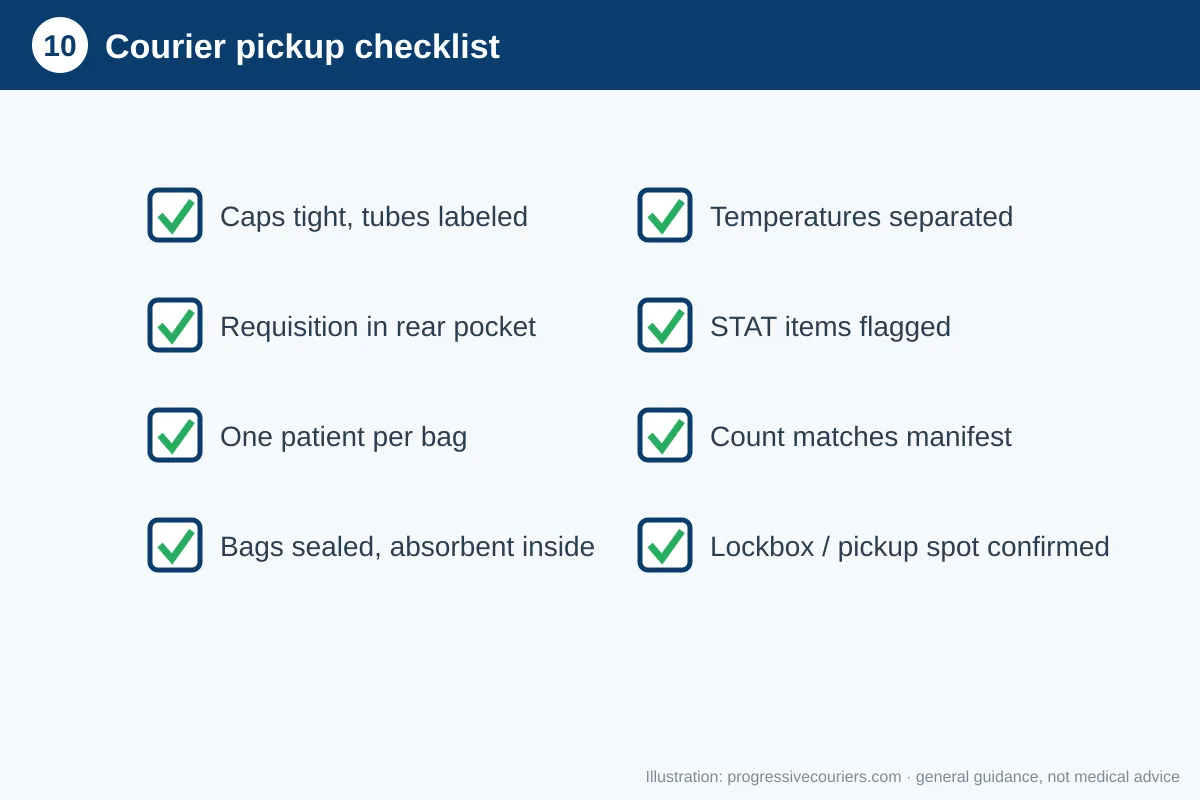
Before the courier arrives: caps tight, every tube labeled with two identifiers, requisition in the rear pocket of the matching bag, one patient per bag, bags sealed with absorbent inside, temperatures separated, STAT and irreplaceable items flagged, and the manifest or log filled out with the bag count.
At the handoff: confirm the pickup location (inside or lockbox), count bags together, confirm temperature groups, note the time, and get the courier's name or ID. Mention anything unusual — a frozen specimen, a specimen that must stay upright, a light-sensitive tube.
After the handoff: keep your copy of the manifest or tear-off receipts, and follow up promptly if the lab reports a missing or compromised specimen.
Lockboxes and after-hours pickups
Lockboxes let couriers collect specimens after your office closes, but they are exposed to the weather. Place them out of direct sun when possible, use the insulated lockbox or keeper your lab provides, add a conditioned pack in hot weather if the lab recommends it, and do not leave frozen specimens in a lockbox unless the lab's frozen keeper system is designed for it. Put specimens out as late as practical and keep the area secure.
Safety, training and privacy
Anyone who handles blood or other potentially infectious materials on the job is covered by the OSHA Bloodborne Pathogens Standard (29 CFR 1910.1030), which requires an exposure control plan, training, appropriate PPE and procedures for spills and exposures. Keep a spill kit where specimens are packaged and in vehicles that carry them.
Specimen paperwork carries protected health information. Keep requisitions inside the bag's pocket and out of sight, never leave manifests on a dashboard, and use couriers who follow HIPAA-compliant handling practices.
Lab-by-lab packaging guides
Each guide below summarizes what that laboratory publishes about packaging and transport, with links to the lab's own pages. Where we could not verify lab-specific details, the guide says so and links to the official source.
National reference laboratories
- Quest Diagnostics specimen packaging & transport guide
- Labcorp specimen packaging & transport guide
- Sonic Healthcare USA specimen packaging & transport guide
- ARUP Laboratories specimen packaging & transport guide
- Mayo Clinic Laboratories specimen packaging & transport guide
- BioReference Laboratories specimen packaging & transport guide
Arizona hospital and regional laboratories
- Sonora Quest Laboratories specimen packaging & transport guide
- Banner Health specimen packaging & transport guide
- HonorHealth specimen packaging & transport guide
- Dignity Health / CommonSpirit (Arizona) specimen packaging & transport guide
- Mayo Clinic Arizona specimen packaging & transport guide
- Phoenix Children's specimen packaging & transport guide
- Valleywise Health specimen packaging & transport guide
Austin and Texas laboratories
Frequently asked questions
- How should lab specimens be packaged for transport?
- Use triple packaging: a tightly capped, labeled primary receptacle; a leak-proof secondary bag with enough absorbent for all the liquid; and rigid outer packaging. Put the requisition in the bag's separate rear pocket, keep one temperature per bag, and mark the outer package as required (UN3373 for Category B).
- Where does the requisition go in a specimen bag?
- In the separate rear (outer) pocket of a two-pouch specimen bag, folded with the barcode and patient name facing out when the lab asks for it. The specimen goes in the sealed front pouch so paperwork stays dry if a tube leaks.
- What is UN3373?
- UN3373 is the identification number for "Biological Substance, Category B" — infectious substances that do not meet Category A criteria. Packages must meet 49 CFR 173.199 and show the UN3373 diamond mark with the proper shipping name.
- Do I need a 95 kPa bag?
- For liquid Category B specimens transported by air, either the primary receptacle or the secondary packaging must withstand a 95 kPa pressure differential. For ground-only courier transport it is generally not required, but follow your lab's instructions.
- Can refrigerated and frozen specimens go in the same bag?
- No. Keep ambient, refrigerated and frozen specimens in separate bags, usually with separate requisitions or copies, and physically separated in the transport container.
- Can dry ice be sealed in an airtight container?
- No. Dry ice releases carbon dioxide gas as it sublimates and must be allowed to vent. Sealing it can rupture the package. Air shipments with dry ice need the Class 9 label, UN1845 and the net weight.
- Does Progressive Couriers transport Category A specimens?
- No. We transport ordinary clinical specimens, including Category B and exempt specimens, in the Phoenix metro and Arizona and in the Austin, TX area. We do not accept Category A infectious substances.
- Is this guide medical or regulatory advice?
- No. It is general information. Always follow the receiving laboratory's test directory and current DOT, IATA and OSHA requirements, and consult your lab or a qualified trainer for specific situations.
Lab specimen transport requirements: packaging, temperature & chain of custody →
OSHA bloodborne pathogens & specimen transport requirements →
Not medical, legal or regulatory advice. This guide is general information last reviewed 2026-10-31. Requirements change; always follow the receiving laboratory's current test directory and instructions, and current DOT, IATA and OSHA rules. Illustrations are original diagrams for general education.
Questions? 602-499-2672