Lab Specimen Transport Requirements
Transporting lab specimens safely means four things: seal each specimen in triple packaging (a leakproof primary tube, a sealed secondary bag with absorbent, and a rigid outer box or cooler); hold the required temperature; send the requisition in a separate outer pouch; and record every hand-off in a chain of custody.
Updated 2026-11-01
Core Transport Requirements
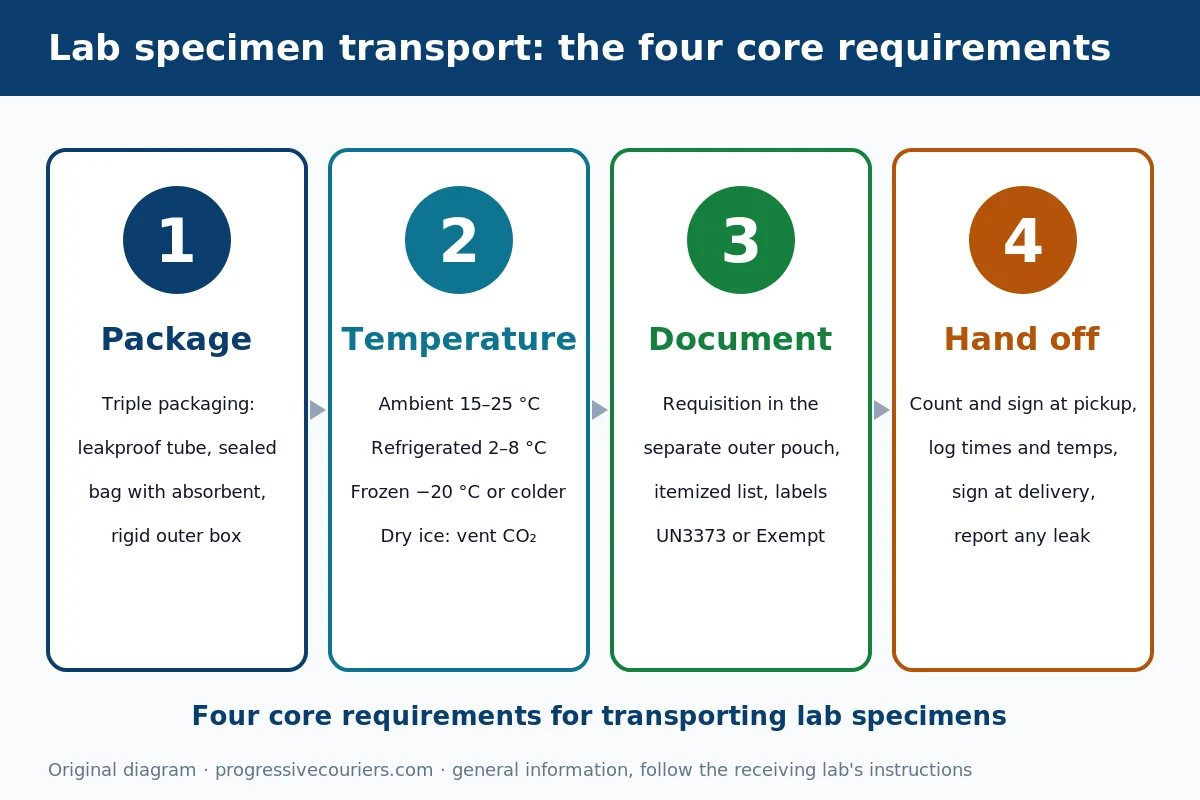
Every clinical specimen that leaves the room where it was collected must arrive at the laboratory intact, identifiable, at the right temperature and within the stability window for the test. The rules that get it there come from a few places. OSHA’s Bloodborne Pathogens Standard covers the people who handle the specimen. The Department of Transportation’s Hazardous Materials Regulations, and IATA’s Dangerous Goods Regulations when a package flies, cover the package. The receiving laboratory’s test directory covers the specimen itself: tube type, volume, temperature and how long it can travel.
Most routine patient specimens moved between clinics, hospitals and reference labs are either Category B infectious substances (UN3373, “Biological substance, Category B”) or exempt human specimens. Category A substances, which can cause permanent disability or life-threatening disease in otherwise healthy people, have much stricter packaging and training rules and are outside the scope of this page.
- Classify the specimen: exempt human specimen, Category B (UN3373) or Category A. When you are unsure, ask the receiving laboratory.
- Use a leakproof primary receptacle labelled with at least two patient identifiers.
- Seal it in leakproof secondary packaging with enough absorbent for the full liquid volume.
- Place the secondary packaging in rigid outer packaging, and mark it UN3373 or “Exempt human specimen”.
- Hold the required temperature from collection to receipt: ambient, refrigerated or frozen.
- Keep the requisition and any itemized list outside the secondary bag, in a separate pouch or between the secondary and outer packaging.
- Record each hand-off, with names, times, specimen count and condition, until the lab signs for it.
Sources: OSHA — 29 CFR 1910.1030, Bloodborne Pathogens · DOT (eCFR) — 49 CFR 173.199, Category B infectious substances · CDC — Submit and Ship Specimens
Triple-Packaging System
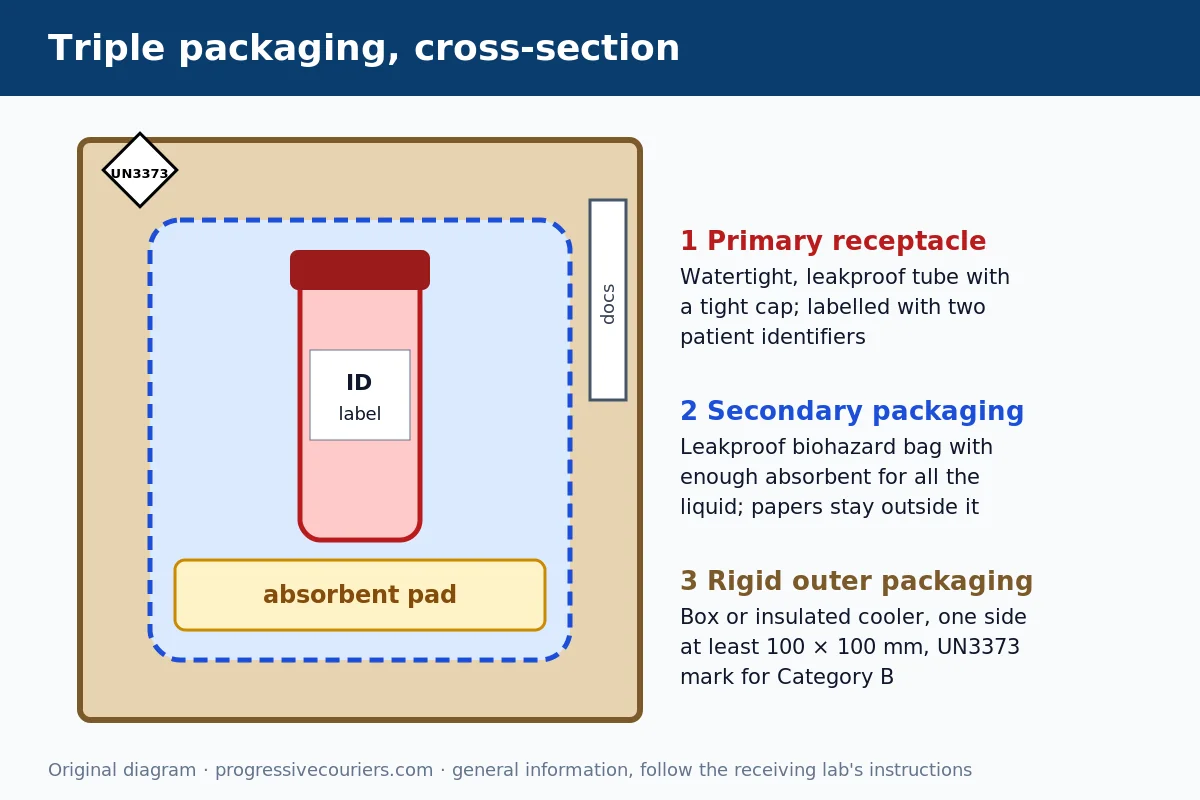
Triple packaging is the basic rule for Category B specimens in 49 CFR 173.199 and for exempt human specimens, and it matches the OSHA requirement that specimens travel in a container that prevents leakage. Each layer has one job, so if one fails the next one holds.
- Primary receptacle: a watertight, leakproof tube or container with a secure cap (screw caps taped or sealed if the lab asks). It holds the specimen and the patient label.
- Secondary packaging: a leak-resistant biohazard bag or canister, sealed, with absorbent material between the primary and secondary that can take up the entire liquid contents. Several tubes may share one secondary only if each is wrapped or separated so they cannot touch. Most specimen bags have a separate document pouch on the outside for the requisition.
- Outer packaging: a rigid box, transport tote or insulated cooler strong enough for its size and use. For Category B shipments, at least one surface must be at least 100 mm × 100 mm, and the completed package must pass the 1.2 m drop test described in 173.199.
For air transport, the primary or the secondary packaging for liquids must withstand a 95 kPa pressure differential without leaking, and quantity limits apply: no more than 1 L per primary receptacle for liquids and no more than 4 L or 4 kg per outer package, under IATA Packing Instruction 650.
Triple packaging for specimens, step by step →
Sources: DOT (eCFR) — 49 CFR 173.199, Category B infectious substances · OSHA — 29 CFR 1910.1030, Bloodborne Pathogens · CDC — Packing Category A, B and Exempt Specimens job aid (PDF)
Temperature Requirements
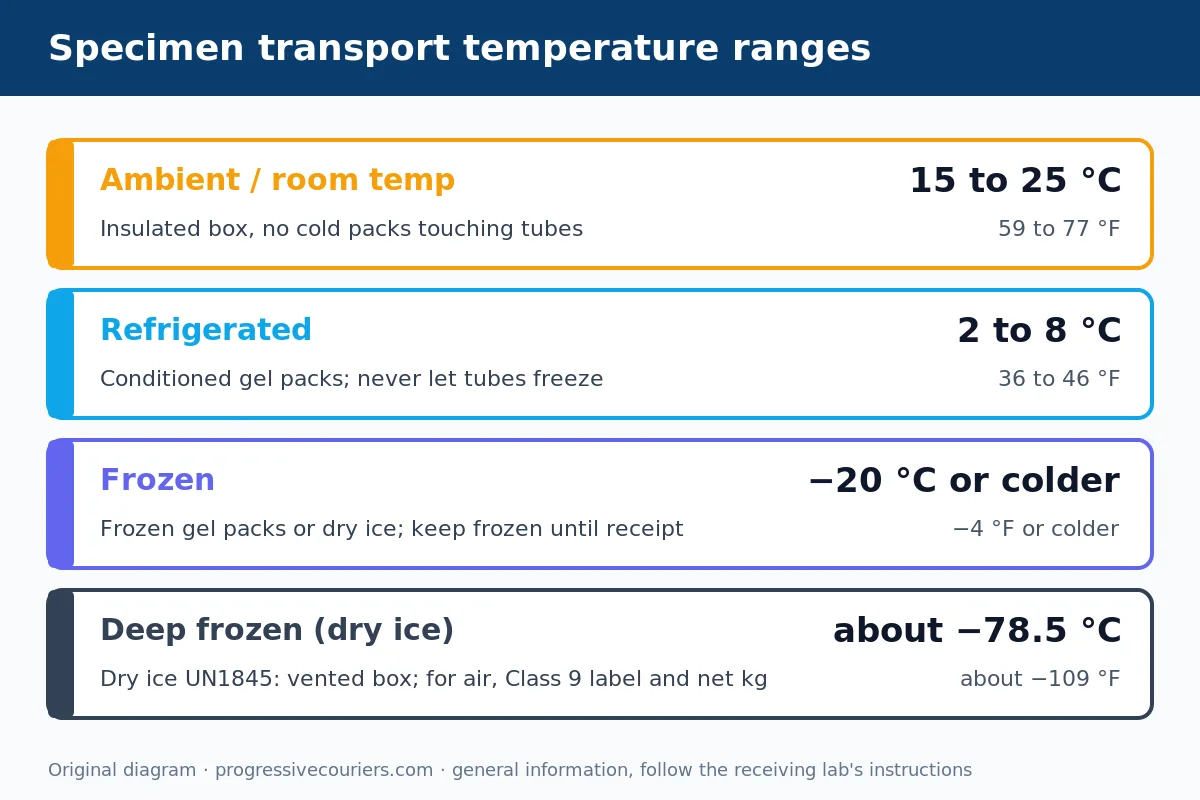
The test, not the courier, sets the temperature. The receiving lab’s test directory lists the required condition for each test and how long the specimen stays stable at that condition. Most specimens fall into one of three bands, and each band has its own packing method.
| Condition | Range | How it is held | Typical use |
|---|---|---|---|
| Ambient (room temperature) | 15–25 °C (59–77 °F) | Insulated box, no cold packs | Many whole-blood and routine specimens |
| Refrigerated | 2–8 °C (36–46 °F) | Refrigerator-conditioned gel packs with a barrier | Many serum, plasma and urine specimens |
| Frozen | −20 °C (−4 °F) or colder | Frozen gel packs or dry ice | Specimens the test directory lists as frozen |
| Deep frozen | −70 °C (−94 °F) or colder | Dry ice (UN1845) in a vented shipper | Specimens for special testing |
The receiving laboratory’s test directory sets the required range and stability time for each test.
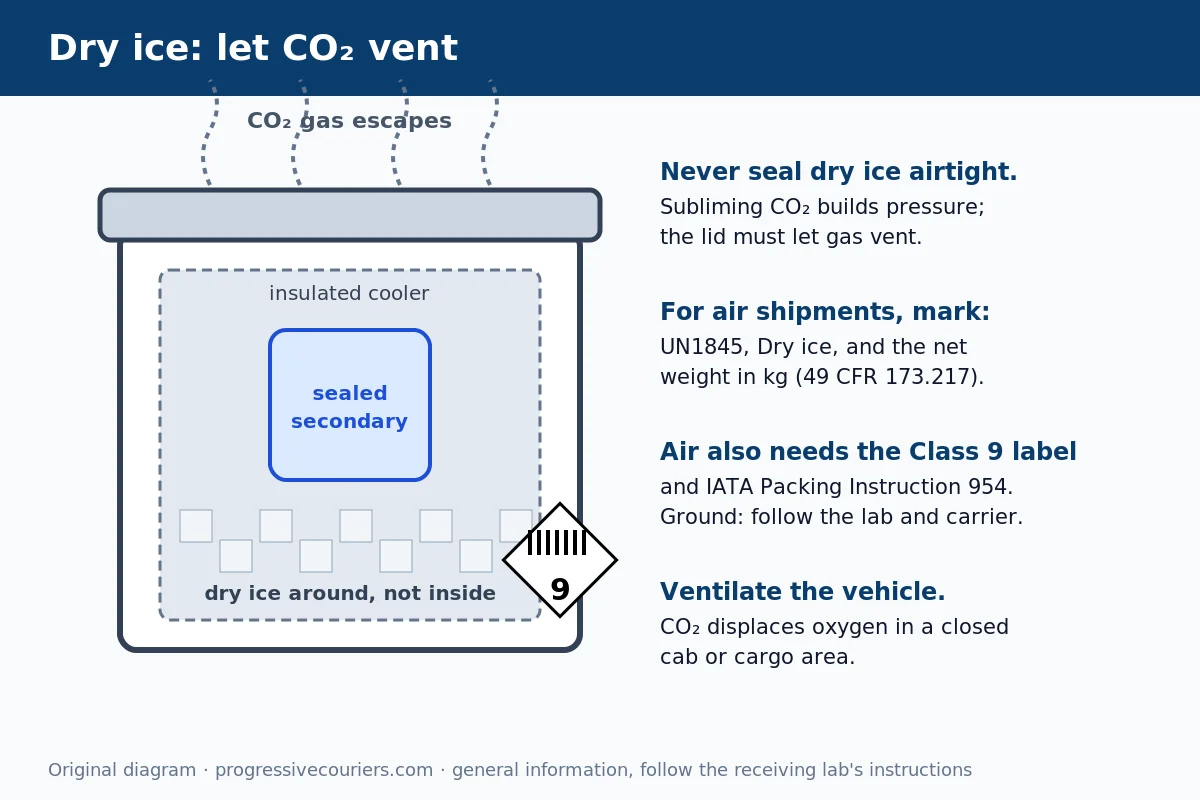
Dry ice (solid carbon dioxide, UN1845) needs extra care. It must never be sealed in an airtight container: as it sublimates it releases CO₂ gas, which builds pressure and can burst a sealed box. On every trip, pack it outside the secondary packaging, use an outer package that lets gas escape, and keep vehicles ventilated. For air (and water) shipments, 49 CFR 173.217 and IATA add marking rules: “UN1845” and “Dry ice” (or “Carbon dioxide, solid”), the net weight in kilograms, and the Class 9 hazard label. Many labs and carriers ask for the same marks on ground packages, so follow the receiving lab’s and carrier’s instructions.
Specimen transport temperature ranges in detail →
Sources: DOT (eCFR) — 49 CFR 173.217, Carbon dioxide, solid (dry ice) · IATA — Dangerous Goods Regulations · CDC — Submit and Ship Specimens
Documentation & Chain of Custody
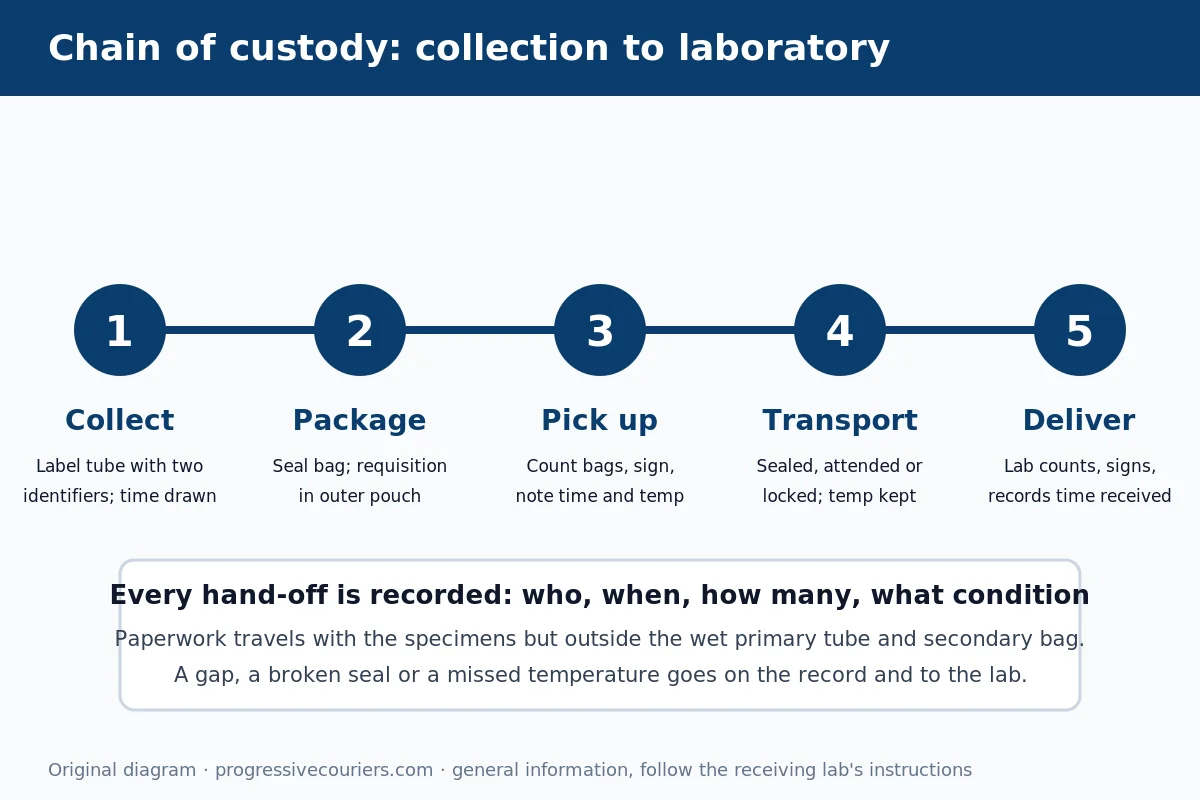
Paperwork travels with the specimen but never with the wet primary tube. Put the requisition in the outer document pouch of the specimen bag, or between the secondary and outer packaging, so a leak cannot ruin it and the lab can read it without opening the bag. For Category B packages, an itemized list of contents goes between the secondary and outer packaging, and the name and phone number of a person responsible for the shipment must be on the package or the shipping document.
Chain of custody is the written record of who had the specimen and when. A practical courier record captures:
- Pickup location, the name of the person who released the specimens, and the time.
- Number of bags or containers and their temperature condition.
- The driver’s name and any transfer between drivers or vehicles.
- Delivery location, the receiving person’s name and the time received.
- Exceptions: a leak, a broken seal, a temperature excursion or a late arrival, reported to both the sender and the lab.
Requisitions contain protected health information, so they stay face-down or covered, specimens are never left unattended in an open vehicle, and only the minimum information needed is shared. Forensic and workplace drug-testing specimens use formal custody forms and tamper-evident seals; follow that program’s own form.
Specimen chain of custody, step by step →
Sources: eCFR — 42 CFR 493.1242, Specimen submission, handling, and referral (CLIA) · HHS — The HIPAA Privacy Rule · DOT (eCFR) — 49 CFR 173.199, Category B infectious substances
Who is responsible for what
The sending facility classifies, packages and labels the specimen and fills out the requisition. The courier keeps the package sealed, upright, at temperature and attended, follows the receiving lab’s cutoff times, and records each hand-off. The laboratory checks the specimen on receipt against its acceptance criteria and may reject a specimen that leaked, warmed, froze when it should not have, or arrived unlabelled.
Everyone who handles specimens on the job is covered by OSHA 29 CFR 1910.1030, which requires an exposure control plan, training, gloves and other PPE, and a way to deal with spills. Anyone who prepares or offers a hazardous-materials package for transport needs DOT hazmat training for that function.
Frequently asked questions
- What are the requirements for transporting lab specimens?
- Use triple packaging (leakproof primary tube, sealed secondary bag with absorbent, rigid outer box or cooler), keep the temperature the test requires, send the requisition in a separate outer pouch, mark the package UN3373 or Exempt human specimen, and record a chain of custody from pickup to delivery.
- What is triple packaging for specimens?
- Three layers: a leakproof primary receptacle that holds the specimen, a leakproof secondary package with enough absorbent for all the liquid, and a rigid outer package. It is required for Category B (UN3373) specimens by 49 CFR 173.199 and is standard practice for exempt specimens.
- What temperature should lab specimens be transported at?
- Whatever the lab’s test directory specifies. Common bands are ambient 15–25 °C, refrigerated 2–8 °C with conditioned gel packs, and frozen at −20 °C or colder with frozen packs or dry ice.
- Can dry ice be sealed in a cooler with specimens?
- No. Dry ice gives off carbon dioxide gas and must be allowed to vent. Pack it outside the secondary packaging in an outer package that lets gas escape. For air shipments, mark it UN1845 with the net weight in kg.
- Where does the requisition go when transporting specimens?
- In the separate document pouch on the outside of the specimen bag, or between the secondary and outer packaging, never inside the bag with the wet primary tube.
- Does OSHA apply to specimen couriers?
- Yes, when contact with blood or other potentially infectious materials is reasonably anticipated. OSHA 29 CFR 1910.1030 requires the employer to have an exposure control plan, training, PPE and spill procedures.
- What is the difference between UN3373 and exempt human specimens?
- UN3373 (Category B) applies to specimens that could contain pathogens but do not meet Category A criteria. Exempt human specimens have minimal likelihood of containing pathogens, based on professional judgment, and are marked “Exempt human specimen”. Both use triple packaging.
Official sources
- CDC — Submit and Ship Specimens
- CDC — Packing Category A, B and Exempt Specimens job aid (PDF)
- OSHA — 29 CFR 1910.1030, Bloodborne Pathogens
- DOT (eCFR) — 49 CFR 173.199, Category B infectious substances
- DOT (eCFR) — 49 CFR 173.217, Carbon dioxide, solid (dry ice)
- PHMSA — Transporting Infectious Substances Safely
- IATA — Dangerous Goods Regulations
- WHO — Guidance on regulations for the transport of infectious substances
- eCFR — 42 CFR 493.1242, Specimen submission, handling, and referral (CLIA)
- HHS — The HIPAA Privacy Rule
Related guides
- Triple Packaging for Lab Specimens
- Specimen Transport Temperature Ranges
- Specimen Chain of Custody During Transport
- Specimen Transport Supplies Checklist
- Specimen packaging & transport guide (by lab)
- Specimen packaging resources
- OSHA bloodborne pathogens & specimen transport
Medical couriers by city
Arizona: Phoenix · Mesa · Scottsdale · Tempe · Chandler · Gilbert · Glendale · OSHA-trained couriers in Phoenix
Austin, TX area: Austin · Round Rock · Cedar Park · Georgetown · Pflugerville · San Marcos · OSHA-trained couriers in Austin
Not medical, legal or regulatory advice. General information last reviewed 2026-11-01; regulations change, so read the current official text linked above and follow the receiving laboratory’s instructions. Progressive Couriers is an independent courier and is not affiliated with any laboratory or supplier named on this page. Illustrations are original diagrams.
Questions? 602-499-2672