OSHA Bloodborne Pathogens Training & Specimen Transport Requirements for Medical Couriers
1030) applies to any employee with reasonably anticipated contact with blood or other potentially infectious materials, which can include couriers who handle clinical specimens. 199) and, for air, by IATA. Drivers are bonded & insured, HIPAA-compliant and OSHA-trained. Every delivery is GPS-tracked and closed out with proof of delivery.
Does OSHA’s bloodborne pathogens standard apply to couriers?
The Bloodborne Pathogens Standard, 29 CFR 1910.1030, applies to “all occupational exposure to blood or other potentially infectious materials.” OSHA defines occupational exposure as reasonably anticipated skin, eye, mucous membrane, or parenteral contact with blood or other potentially infectious materials (OPIM) that may result from an employee’s duties. The standard is not limited to hospitals or labs. What matters is the task, not the job title.
A courier who picks up sealed specimen bags from a clinic lockbox may rarely touch anything but the outside of a bag. Leaks still happen. A cap loosens in summer heat, a tube cracks in a dropped cooler, or a bag arrives with blood on the outside. When an employer reasonably expects that drivers could contact blood or OPIM during those events, the driver’s job classification belongs in the employer’s exposure determination. The protections of the standard then follow: a written plan, training, vaccination, PPE, and records.
OPIM is broader than many people expect. Besides blood, it includes semen, vaginal secretions, cerebrospinal, synovial, pleural, pericardial, peritoneal and amniotic fluid, saliva in dental procedures, any body fluid visibly contaminated with blood, and all body fluids where you cannot tell them apart. It also includes unfixed human tissue or organs, and certain HIV- or HBV-containing cultures. In practice, nearly every clinical specimen a medical courier carries is either blood or OPIM.
The written exposure control plan
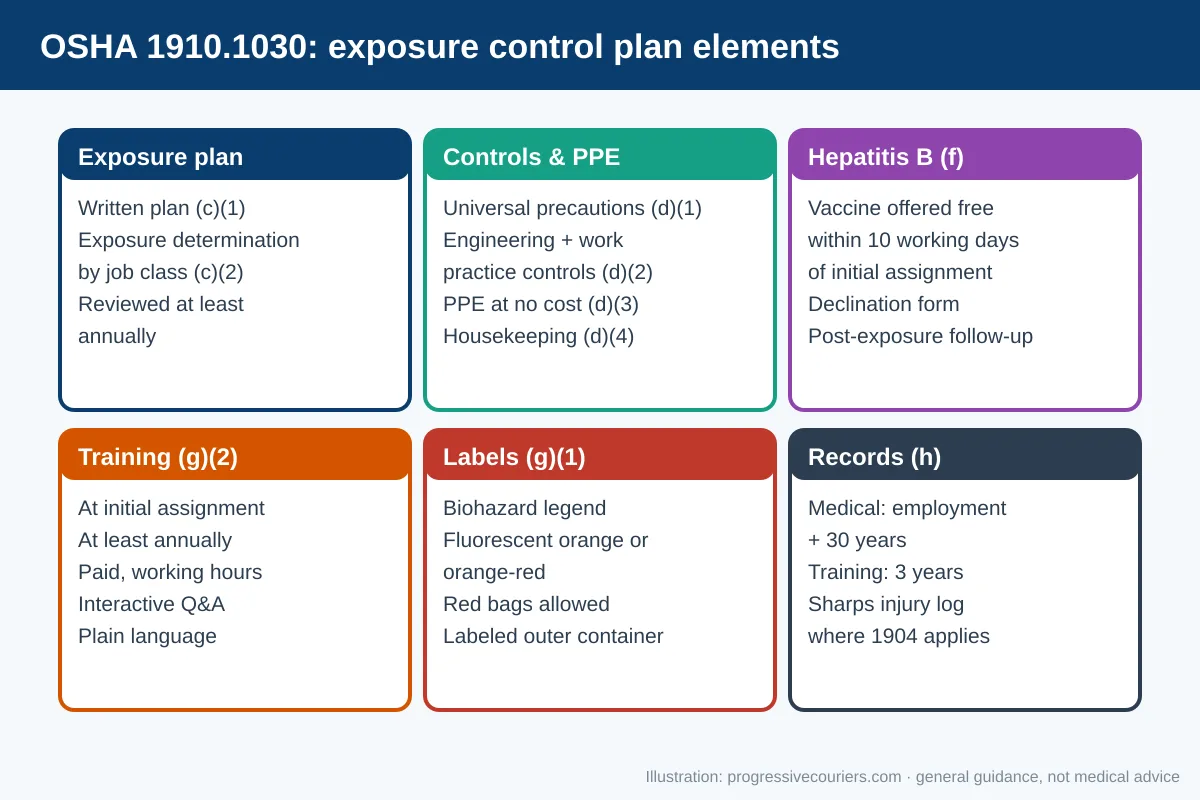
Every employer with an employee who has occupational exposure must establish a written exposure control plan designed to eliminate or minimize that exposure. At a minimum the plan contains three things: the exposure determination, the schedule and method for putting the rest of the standard in place (methods of compliance, hepatitis B vaccination and post-exposure follow-up, communication of hazards, and recordkeeping), and the procedure for evaluating the circumstances of exposure incidents.
The exposure determination lists the job classifications in which all employees have exposure, those in which some do, and the tasks and procedures where exposure occurs. It must be made without regard to PPE. In other words, you cannot reason that drivers wear gloves and are therefore not exposed. For a courier company, the tasks typically include receiving specimen bags from staff or lockboxes, transferring bags into transport containers, handling a leaking or contaminated package, and cleaning a vehicle or cooler after a spill.
The plan must be accessible to employees and reviewed and updated at least annually. It must also be updated whenever new or modified tasks, procedures, or positions affect exposure. Employers who must have a plan must make it available to OSHA and NIOSH on request.
Sources: OSHA — 29 CFR 1910.1030, Bloodborne Pathogens · OSHA — Bloodborne Pathogens and Needlestick Prevention
Universal precautions, engineering and work-practice controls
The standard requires universal precautions: treat all human blood and certain body fluids as if known to be infectious. Where body fluid types cannot be told apart, all body fluids are considered potentially infectious. A courier never has to decide whether a specimen is “risky.” Every specimen is handled the same way.
Engineering and work-practice controls are the first line of defense, with PPE added where exposure remains. For specimen transport, the most relevant provisions are in paragraph (d)(2)(xiii). Specimens of blood or OPIM must be placed in a container that prevents leakage during collection, handling, processing, storage, transport, or shipping. The container must be labeled or color-coded and closed before it is stored, transported, or shipped. If the outside of the primary container becomes contaminated, it goes inside a second leak-proof, labeled container. If the specimen could puncture the primary container, the secondary container must also be puncture-resistant.
One detail matters for anyone who moves specimens between buildings. A facility that applies universal precautions to all specimens may skip labeling while the specimens stay inside the facility. Labeling or color-coding is required once specimens or containers leave the facility. A specimen headed out with a courier needs an appropriately labeled container.
Other work-practice rules apply in a vehicle just as in a lab. Hands are washed immediately or as soon as feasible after removing gloves. Where running water is not available, the employer provides an antiseptic hand cleanser or towelettes, and hands are washed with soap and water as soon as feasible. Eating, drinking, and applying cosmetics are prohibited where there is a reasonable likelihood of exposure. Broken glassware that may be contaminated is never picked up by hand. It is cleaned up with mechanical means such as a brush and dust pan, tongs, or forceps.
Personal protective equipment for specimen couriers
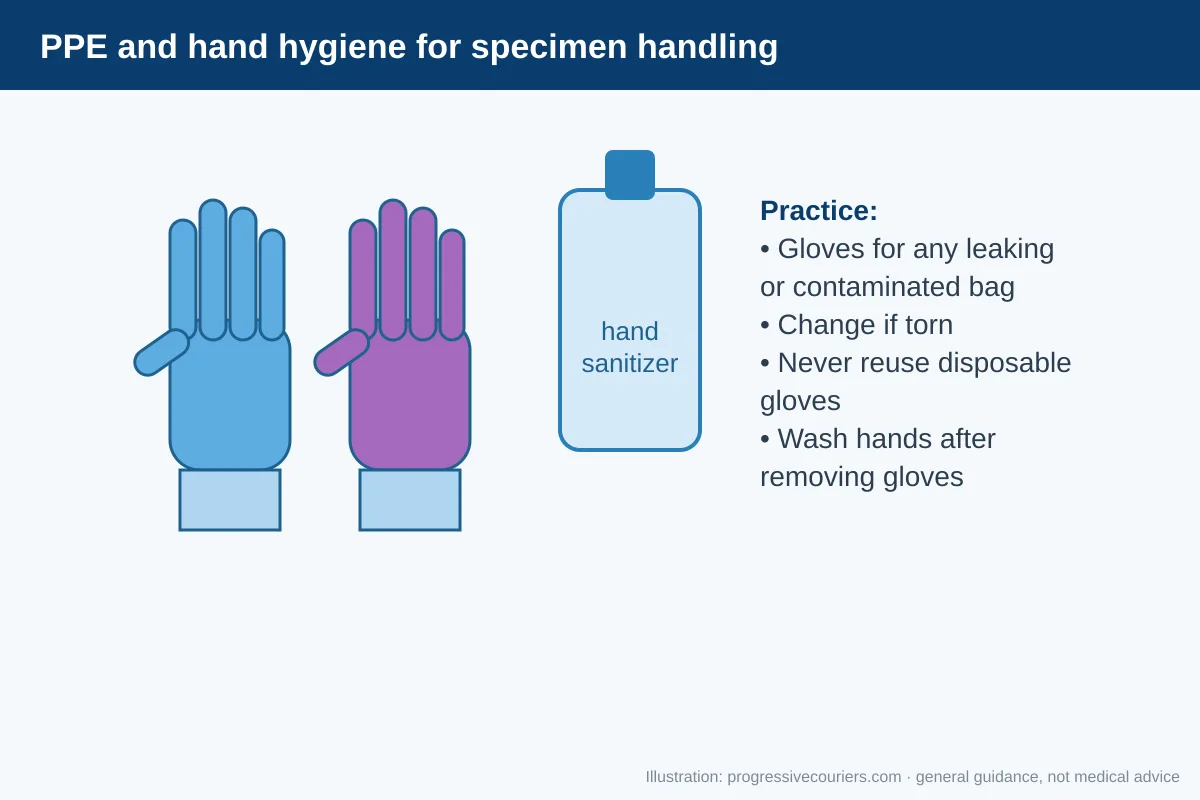
When there is occupational exposure, the employer must provide appropriate PPE at no cost to the employee, in the right sizes, and readily accessible at the worksite or issued to the employee. For a courier the worksite is the vehicle and the pickup and delivery points. Hypoallergenic or powderless alternatives must be available to employees allergic to the standard gloves.
Gloves are required when hand contact with blood, OPIM, or contaminated items or surfaces can reasonably be anticipated. For a driver, that means handling a bag that is leaking or soiled on the outside, or cleaning up a spill. Disposable gloves are replaced as soon as practical when contaminated, torn, or punctured, and are never washed for reuse. Eye and face protection and protective clothing are required where splashes or spatter can reasonably be anticipated. That is uncommon in routine transport, but it can apply during the cleanup of a large spill.
Employers must also clean, launder, dispose of, repair, and replace PPE at no cost to the employee. A garment penetrated by blood or OPIM is removed as soon as feasible, and PPE is removed before leaving the work area and placed in a designated container.
Spill and exposure procedures
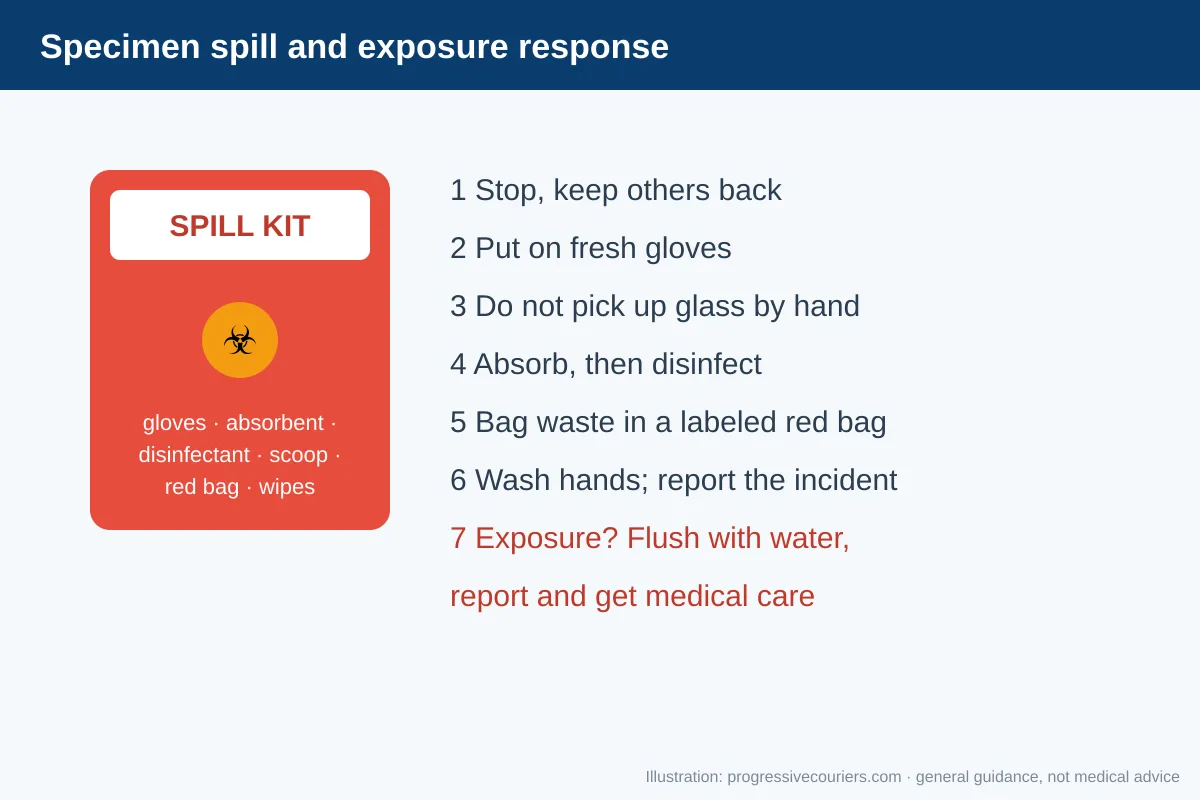
The standard requires that contaminated surfaces be decontaminated with an appropriate disinfectant immediately or as soon as feasible after a spill of blood or OPIM. Reusable bins, pails, and similar receptacles that may become contaminated must be inspected and decontaminated on a regular schedule and cleaned as soon as feasible when visibly contaminated. That applies to the coolers and transport totes a courier reuses every day.
A typical courier spill sequence is: stop and keep others away; put on fresh gloves; never pick up broken glass by hand; absorb the liquid, then disinfect the surface; place the waste in a closable, leak-proof, labeled or red container; wash hands; and report the event to dispatch and the sending facility. Regulated waste must be disposed of according to federal, state, and local rules, so the employer’s plan should say exactly where it goes.
An exposure incident is different from a spill. It means a specific eye, mouth, other mucous membrane, non-intact skin, or parenteral contact with blood or OPIM. OSHA’s guidance for a needlestick or splash is to immediately flood the exposed area with water and clean any wound with soap and water or a skin disinfectant if available, report it to the employer right away, and seek immediate medical attention. The employer must then make a confidential medical evaluation and follow-up immediately available, at no cost to the employee.
Sources: OSHA — 29 CFR 1910.1030, Bloodborne Pathogens · OSHA — Bloodborne Pathogens and Needlestick Prevention
Hepatitis B vaccination
The employer must make the hepatitis B vaccine and vaccination series available, at no cost, to all employees with occupational exposure. It must be offered after the employee has received the required training and within 10 working days of initial assignment. The exceptions are employees who have already completed the series, whose antibody testing shows immunity, or for whom the vaccine is medically contraindicated. Participation in a prescreening program cannot be a condition of vaccination.
An employee may decline. Declining employees sign the declination statement in Appendix A of the standard. An employee who declines but later changes their mind while still covered must be offered the vaccine at that time. All medical evaluations and procedures are provided at a reasonable time and place, performed by or under the supervision of a licensed healthcare professional, and follow current U.S. Public Health Service recommendations.
Bloodborne pathogens training for couriers
Training must be provided at no cost to the employee and during working hours. It happens at the time of initial assignment to tasks where exposure may take place, and at least annually thereafter, within one year of the previous training. Additional training is required when new or changed tasks affect exposure. The material must suit the employees’ education level, literacy, and language.
A common misreading is that training may wait 10 days. The 10-working-day window in the standard applies to the hepatitis B vaccination offer, not to training. Training is required at initial assignment.
The minimum content is spelled out. It covers an accessible copy of the standard and an explanation of it, the epidemiology, symptoms, and modes of transmission of bloodborne diseases, and the employer’s exposure control plan and how to get a copy. Trainees learn how to recognize exposure tasks, the use and limits of controls, work practices, and PPE, and the types, use, location, removal, handling, decontamination, and disposal of PPE. Training also explains the hepatitis B vaccine, including that it is free, what to do and whom to contact in an emergency, how to report an exposure and the follow-up that will be provided, and the signs, labels, and color coding the standard requires. Trainees must have a chance for interactive questions and answers with a trainer who is knowledgeable about the subject as it applies to the workplace.
For a courier, a good program goes beyond the regulatory minimum and walks through real scenarios. Examples include a cracked tube found at a lockbox, a cooler that tipped during a hard stop, or a bag handed over with blood on the outside. Each scenario connects to the company’s own plan and spill kit.
Biohazard labels and color coding
Warning labels are required on containers of regulated waste, on refrigerators and freezers containing blood or OPIM, and on other containers used to store, transport, or ship blood or OPIM. Labels bear the biohazard legend, are fluorescent orange or orange-red (or predominantly so) with contrasting lettering, and are attached so they cannot be lost or removed unintentionally. Red bags or red containers may be substituted for labels.
Two exemptions matter in transport. Individual containers placed inside a labeled container during storage, transport, shipment, or disposal do not need their own label. Blood products labeled as to their contents and released for transfusion or other clinical use are also exempt. In practice, a labeled specimen bag or labeled transport cooler covers the tubes inside it.
OSHA labeling is separate from DOT marking. The OSHA biohazard symbol warns workers. The DOT UN3373 mark on a Category B package tells carriers how it is classified for transportation. A package can need both.
Recordkeeping
Medical records for each employee with occupational exposure include their hepatitis B vaccination status and dates, exam and follow-up results after any exposure incident, and the healthcare professional’s written opinion. They are kept confidential and retained for the duration of employment plus 30 years, under 29 CFR 1910.1020.
Training records include session dates, a summary of contents, the names and qualifications of the trainers, and the names and job titles of attendees. They are kept for 3 years from the date of the training. Employers that must keep an OSHA 300 injury and illness log under 29 CFR Part 1904 must also keep a sharps injury log that protects the injured employee’s confidentiality.
DOT / PHMSA: 49 CFR Parts 171–180 and UN3373 Category B
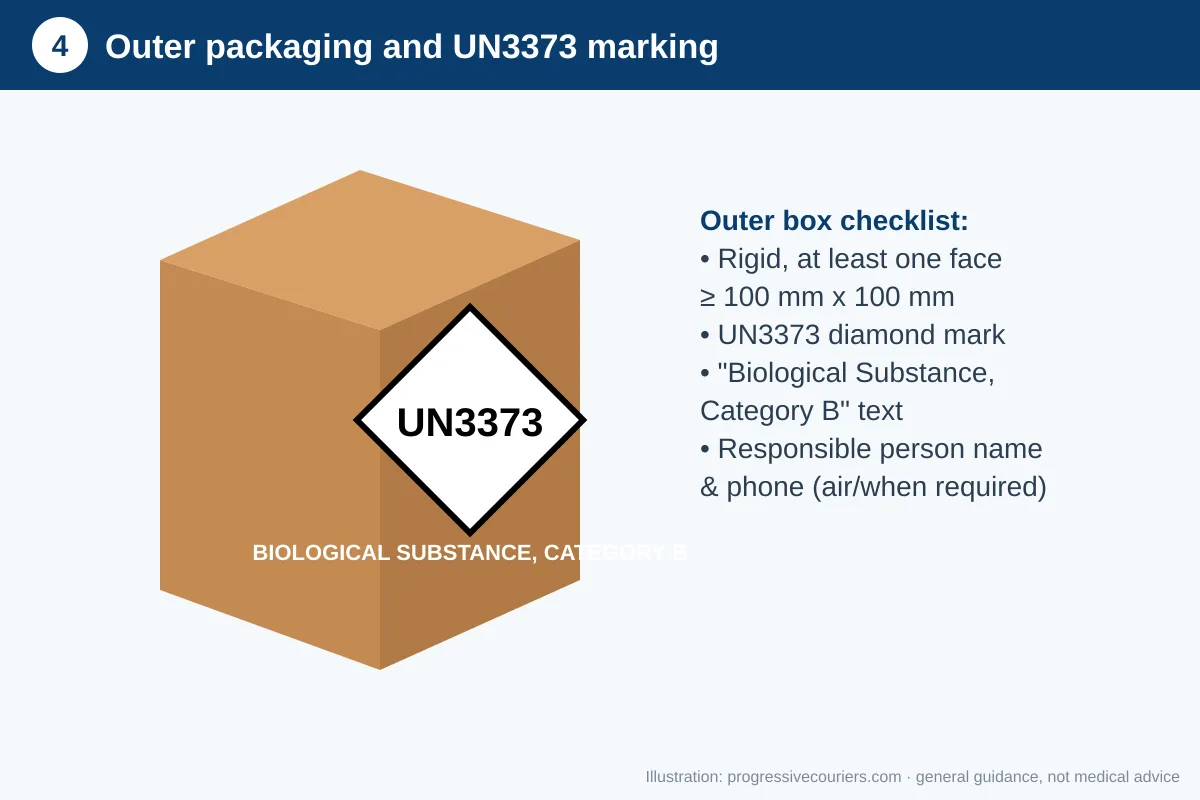
OSHA protects workers. The U.S. Department of Transportation’s Hazardous Materials Regulations (HMR), 49 CFR Parts 171–180 administered by PHMSA, govern how infectious substances are classified, packaged, marked, and documented for transportation in commerce. Most diagnostic and clinical specimens that may contain pathogens are shipped as UN3373, “Biological substance, Category B,” under 49 CFR 173.199.
Section 173.199 requires triple packaging. The first layer is a leak-tight primary receptacle. The second is leak-tight secondary packaging with enough absorbent material between the primary and secondary layers to absorb the entire contents of the primary receptacles. The third is rigid outer packaging. The completed package must be marked with the UN3373 diamond and the words “Biological Substance, Category B.” The regulation also sets drop-test performance, receptacle quantity limits, and extra pressure requirements when the shipment goes by air.
Category A infectious substances, those capable of causing permanent disability or life-threatening disease in otherwise healthy people, are shipped as UN2814 or UN2900 in UN-specification packaging under 49 CFR 173.196, with full hazmat training and documentation. Progressive Couriers transports ordinary clinical specimens, including Category B (UN3373) and exempt specimens. We do not accept Category A infectious substances.
Under the HMR, employees who perform regulated functions such as classifying, packaging, marking, or documenting must be trained. Section 173.199 has its own training provision for persons who prepare Category B shipments. The full hazmat employee training program in 49 CFR Part 172, Subpart H, has initial and three-year recurrent cycles. The shipper or packaging laboratory is generally responsible for correctly classifying and packaging the specimen before it is handed to a courier.
Sources: eCFR — 49 CFR 173.199, Category B infectious substances · eCFR — 49 CFR 173.196, Category A infectious substances packagings · PHMSA — Transporting Infectious Substances Safely · eCFR — 49 CFR Part 172 Subpart H, hazmat employee training
Triple packaging in one picture
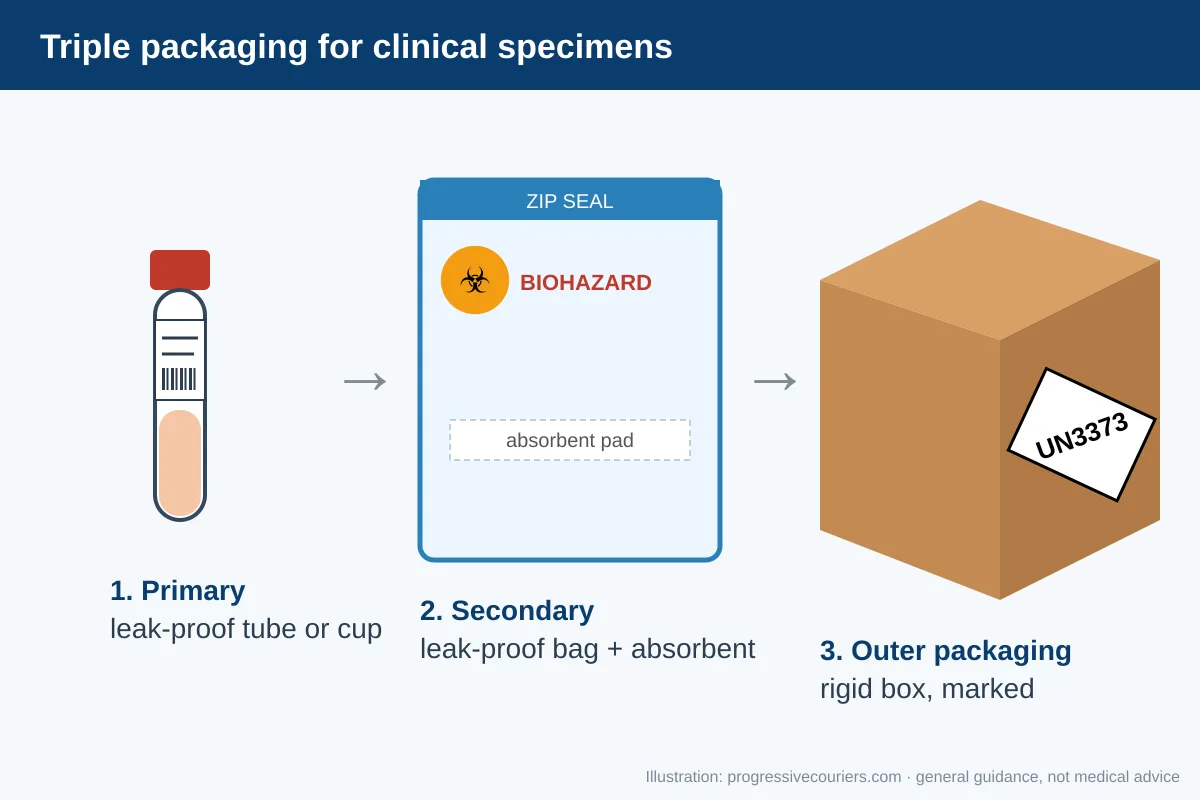
OSHA’s container rule and DOT’s triple packaging work together. A capped, labeled tube in a sealed leak-proof bag with absorbent meets OSHA’s container and secondary-container provisions. Placing that bag in a rigid, marked outer box completes DOT Category B packaging. CDC’s job aid for packing Category A, B and exempt specimens is a practical step-by-step reference. Our specimen packaging guide walks through each layer with diagrams.
Specimen packaging & transport guide →
Sources: eCFR — 49 CFR 173.199, Category B infectious substances · CDC — Submit and Ship Specimens · CDC — Packing Category A, B and Exempt Specimens job aid (PDF)
IATA basics for air shipments
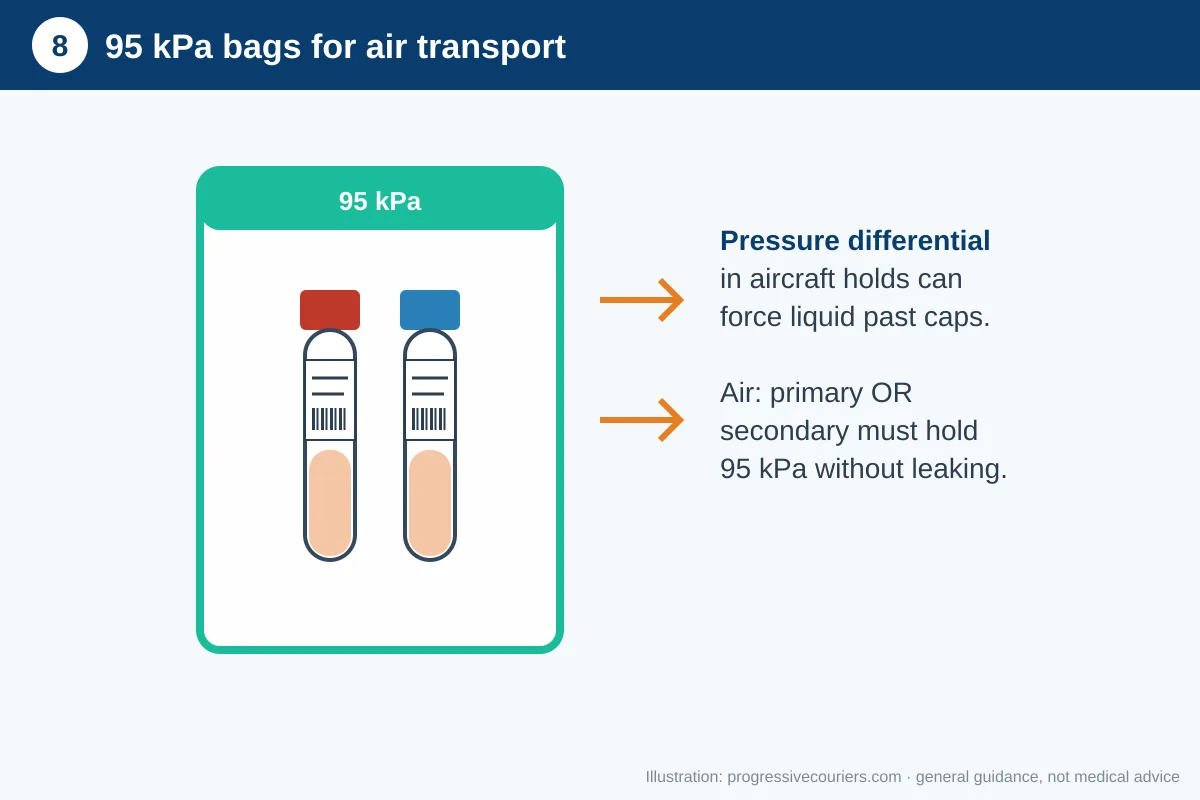
When specimens travel by air, the IATA Dangerous Goods Regulations apply. Packing Instruction 650 covers UN3373. Air adds requirements that ground transport does not, the best-known being that either the primary receptacle or the secondary packaging must withstand a pressure differential of 95 kPa without leaking. Dry ice (UN1845) adds Class 9 labeling and net-weight marking. The WHO guidance on regulations for the transport of infectious substances is a readable international overview of the same classification system.
Local courier runs within the Phoenix metro or the Austin area are ground transport, so IATA rules do not apply to the drive itself. Labs often still pack specimens in 95 kPa bags because the same packaging may later be forwarded by air.
Sources: IATA — Dangerous Goods · WHO — Guidance on regulations for the transport of infectious substances
CLIA and CAP: preanalytic notes for transport
Under CLIA, the federal laboratory quality program administered by CMS, a laboratory must establish and follow written policies for patient preparation, specimen collection, labeling, storage and preservation, conditions for specimen transportation, processing, acceptability and rejection, and referral (42 CFR 493.1242). The laboratory must document the date and time it receives a specimen. A lab that accepts referral specimens must give its clients written instructions covering those items.
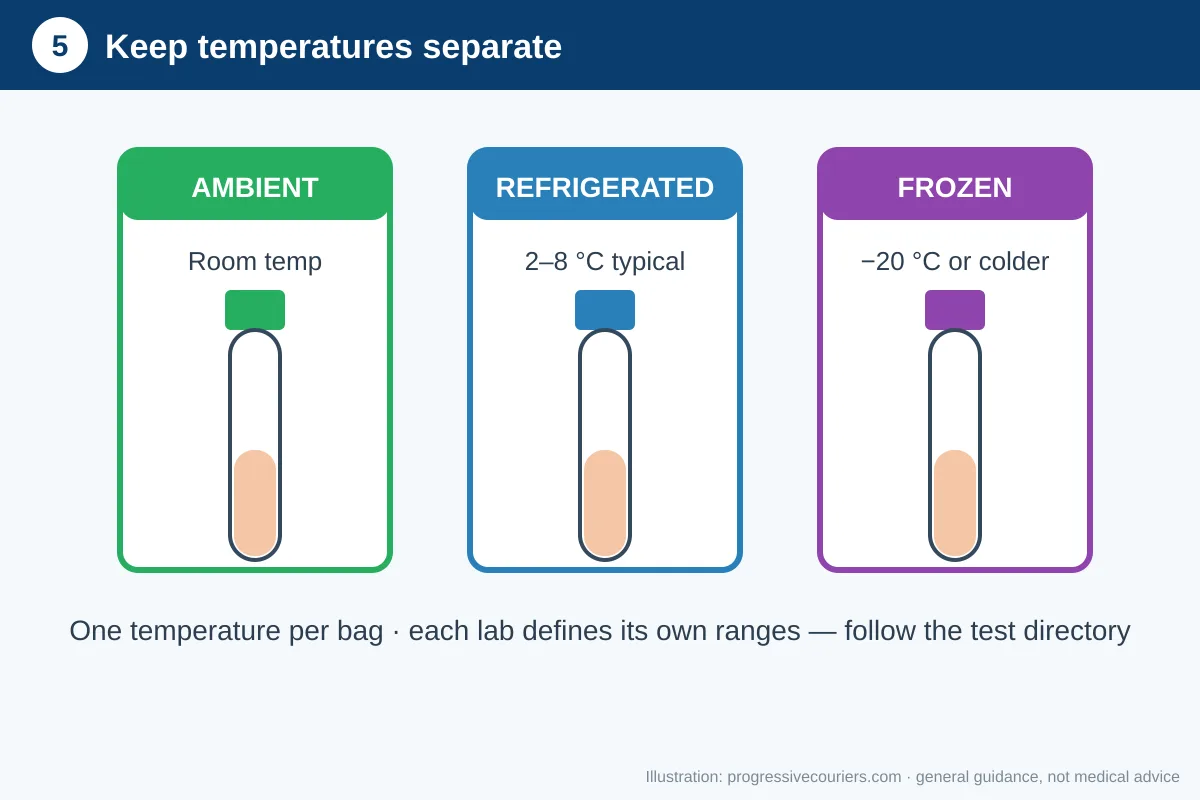
For a courier, this means the receiving lab defines what “acceptable” means: the temperature range, the maximum time from collection, the container, and how the requisition must accompany the specimen. Accrediting organizations such as the College of American Pathologists also assess preanalytic processes, including transport, as part of laboratory accreditation. A courier’s job is to follow those instructions exactly, keep temperatures separated, and give the lab an accurate pickup and delivery time.
Sources: eCFR — 42 CFR 493.1242, Specimen submission, handling, and referral (CLIA) · CMS — Clinical Laboratory Improvement Amendments (CLIA) · College of American Pathologists — Accreditation
HIPAA and chain of custody
Requisitions, labels, and manifests carry protected health information (PHI). The HIPAA Privacy Rule sets national standards for protecting individually identifiable health information and limits its use and disclosure. The Security Rule adds safeguards for electronic PHI, such as the data in a dispatch or tracking system.
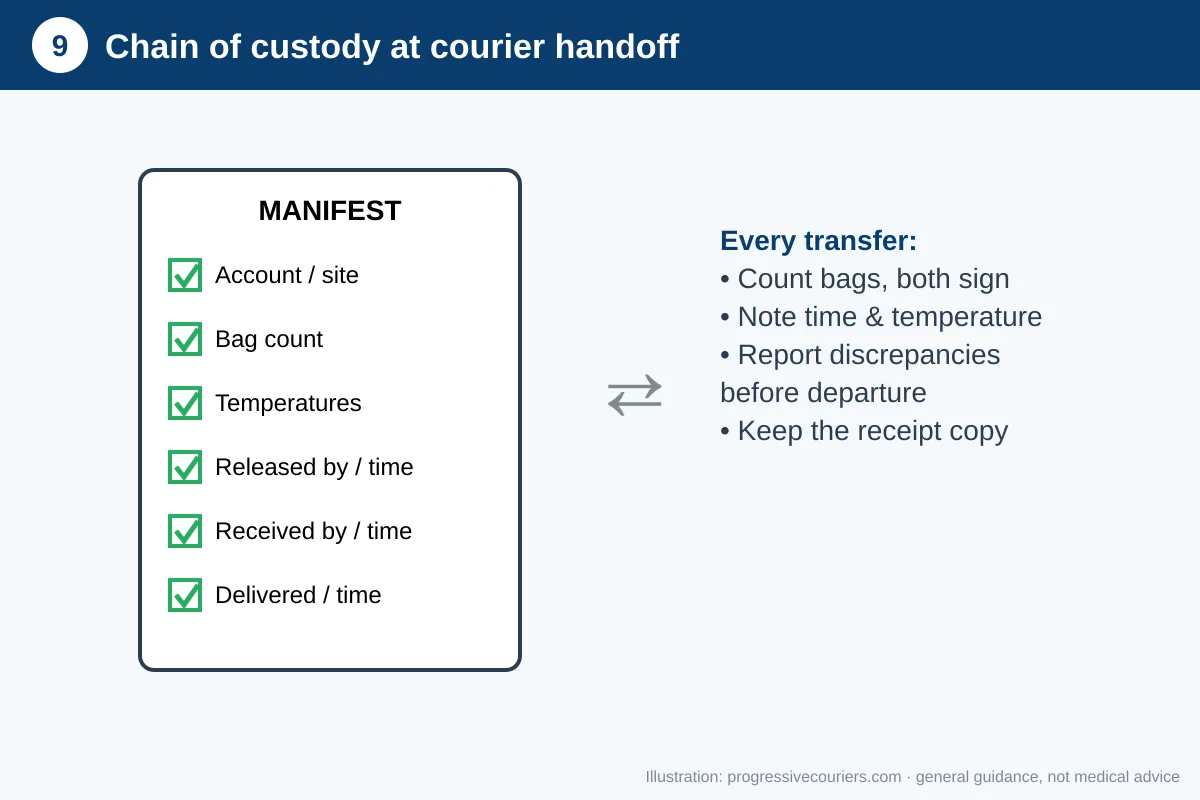
In transport, privacy and chain of custody overlap. Paperwork stays in the specimen bag’s rear pocket and out of sight, bags are never left unattended in an open vehicle, and the handoff records when the specimens were released, how many bags, what temperature, and when they were delivered. That record helps the lab document receipt under CLIA and gives everyone an answer if a specimen is questioned later.
Sources: HHS — The HIPAA Privacy Rule · HHS — The HIPAA Security Rule
Arizona: ADOSH state plan
Arizona operates an OSHA-approved State Plan through the Arizona Division of Occupational Safety and Health (ADOSH), part of the Industrial Commission of Arizona, with its main office in Phoenix. The Arizona State Plan covers most private-sector workplaces in the state, as well as state and local government employers. Exceptions include federal agencies, Indian reservations, and a few industries.
ADOSH has adopted federal OSHA standards by reference, so the Bloodborne Pathogens Standard described above applies to Arizona employers through ADOSH. Arizona also has some state-specific standards. Employers should check the Arizona standards listed on the State Plan page for anything that affects their operation.
Texas: federal OSHA jurisdiction
Texas does not have an OSHA-approved State Plan, so private-sector employers in Texas, including those in Austin and the surrounding towns, are under federal OSHA jurisdiction. 29 CFR 1910.1030 applies to them directly. Federal OSHA does not cover state and local government workers in Texas.
DOT’s Hazardous Materials Regulations and HIPAA are federal and apply the same way in Texas and Arizona. Receiving laboratories in both states set their own specimen-acceptance criteria under CLIA.
Source: OSHA — State Plans (Texas is under federal OSHA jurisdiction)
How Progressive Couriers handles specimens
Progressive Couriers’ drivers are OSHA bloodborne-pathogen trained, our handling is HIPAA-compliant, and we are bonded and insured. We serve the Phoenix metro and Arizona, and the Austin, TX area.
Our process starts with the package. We accept specimens that the sending facility has sealed in leak-proof primary containers inside closed secondary bags with absorbent, and we keep them in that secondary containment for the whole trip. If a bag is leaking or contaminated on the outside at pickup, the driver does not open it. Instead, the driver gloves up, places it in additional containment, and tells the facility before leaving.
Our drivers carry a spill kit and gloves. If something leaks in transit, they follow the spill sequence described above, keep paperwork away from the spill, and report it to dispatch and the sending facility.
Every order keeps a time-stamped record: the pickup time, the bag count, the driver, and the delivery time. Requisitions stay out of sight, and specimens are not left unattended in a vehicle.
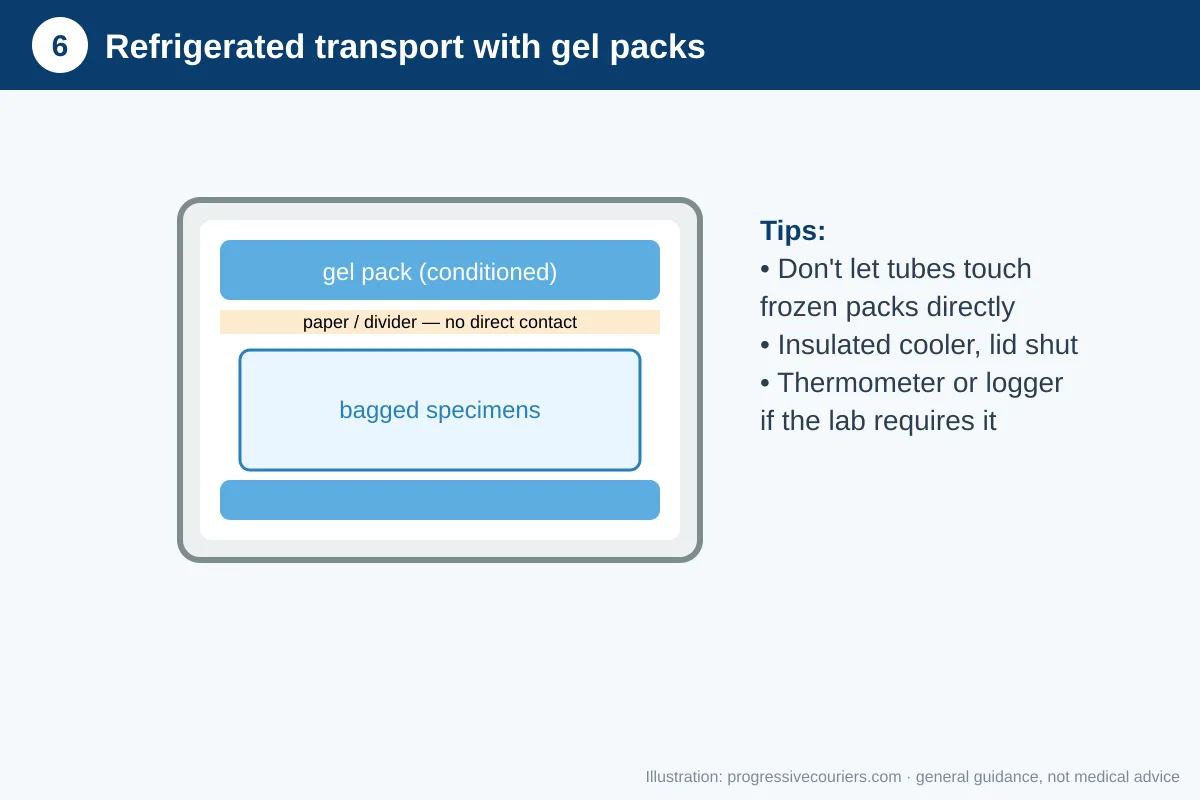
For temperature control, ambient, refrigerated, and frozen items ride in separate insulated containers so one run can carry all three without mixing. Tell us the requirement and any lab cutoff when you book.
We transport Category B (UN3373) and exempt clinical specimens. We do not accept Category A infectious substances. We are an independent courier and are not affiliated with any laboratory or hospital.
Local OSHA-trained medical couriers
Phoenix metro, AZ: Phoenix · Scottsdale · Tempe · Mesa · Chandler · Gilbert · Glendale · Peoria · Surprise · Goodyear · Avondale · Buckeye · Queen Creek · San Tan Valley · Apache Junction · Fountain Hills · Paradise Valley · Cave Creek · Sun City · Sun City West · Litchfield Park · Tolleson · Laveen · Ahwatukee · Anthem · Maricopa · Casa Grande · El Mirage · Youngtown · Gold Canyon
Austin area, TX: Austin · Round Rock · Cedar Park · Georgetown · Pflugerville · Leander · Hutto · Taylor · Manor · Elgin · Bastrop · Kyle · Buda · San Marcos · Lockhart · Lakeway · Bee Cave · Dripping Springs · Liberty Hill · West Lake Hills · Sunset Valley · Rollingwood · Lago Vista · Jonestown · Wimberley · Marble Falls · Hudson Bend · Briarcliff · Point Venture · Spicewood · Horseshoe Bay · Burnet · Bertram · Florence · Jarrell · Salado · Granger · Thrall · Coupland · Webberville · Del Valle · Garfield · Creedmoor · Mustang Ridge · Niederwald · Uhland · Martindale · Luling · Smithville · Paige · McDade · Cedar Creek · Red Rock · Driftwood · Steiner Ranch · Brushy Creek · Anderson Mill · Wells Branch · Shady Hollow · Manchaca · Brodie Lane · New Braunfels · Seguin
Frequently asked questions
- Do medical couriers need OSHA bloodborne pathogens training?
- If a courier’s duties create reasonably anticipated contact with blood or other potentially infectious materials, such as handling a leaking specimen bag or cleaning a spill, OSHA 29 CFR 1910.1030 requires the employer to train them at initial assignment and at least annually, at no cost and during working hours.
- Is bloodborne pathogens training required within 10 days?
- No. Training is required at the time of initial assignment. The 10-working-day window in 29 CFR 1910.1030(f)(2) is for offering the hepatitis B vaccination series, which must be made available after training and within 10 working days of initial assignment.
- How often must bloodborne pathogens training be repeated?
- At least annually, within one year of the previous training, and additionally whenever new or changed tasks affect exposure.
- What are OSHA’s specimen transport requirements?
- Specimens of blood or OPIM must be in a container that prevents leakage during transport, closed and labeled or color-coded before leaving the facility. If the outside is contaminated, the specimen goes in a second leak-proof labeled container, and it must be puncture-resistant if the specimen could puncture the first.
- What is the difference between OSHA rules and DOT rules for specimens?
- OSHA (29 CFR 1910.1030) protects workers from exposure. DOT/PHMSA (49 CFR 171–180) governs how infectious substances are classified, packaged and marked for transportation. Clinical specimens are usually shipped as UN3373 Category B under 49 CFR 173.199.
- How long are bloodborne pathogens training records kept?
- Training records are kept for 3 years from the training date. Employee medical records under the standard are kept for the duration of employment plus 30 years.
- Does Arizona have its own OSHA program?
- Yes. Arizona runs an OSHA-approved State Plan through ADOSH, which has adopted federal OSHA standards, including bloodborne pathogens, by reference. Texas has no State Plan, and its private sector is under federal OSHA.
- Does Progressive Couriers transport Category A infectious substances?
- No. We transport ordinary clinical specimens, including Category B (UN3373) and exempt specimens, in the Phoenix metro, Arizona and the Austin, TX area. We do not accept Category A.
Official sources
- OSHA — 29 CFR 1910.1030, Bloodborne Pathogens
- OSHA — Bloodborne Pathogens and Needlestick Prevention
- OSHA — Arizona State Plan (ADOSH)
- OSHA — State Plans (Texas is under federal OSHA jurisdiction)
- eCFR — 49 CFR 173.199, Category B infectious substances
- eCFR — 49 CFR 173.196, Category A infectious substances packagings
- eCFR — 49 CFR Part 172 Subpart H, hazmat employee training
- PHMSA — Transporting Infectious Substances Safely
- IATA — Dangerous Goods
- WHO — Guidance on regulations for the transport of infectious substances
- CDC — Submit and Ship Specimens
- CDC — Packing Category A, B and Exempt Specimens job aid (PDF)
- eCFR — 42 CFR 493.1242, Specimen submission, handling, and referral (CLIA)
- CMS — Clinical Laboratory Improvement Amendments (CLIA)
- College of American Pathologists — Accreditation
- HHS — The HIPAA Privacy Rule
- HHS — The HIPAA Security Rule
Lab specimen transport requirements → · Specimen packaging & transport guide → · Packaging resources →
Not legal, medical or regulatory advice. General information last reviewed 2026-10-31; regulations change, so read the current official text linked on this page and follow your employer’s exposure control plan and the receiving laboratory’s instructions. Illustrations are original diagrams for general education.
Questions? 602-499-2672