Triple Packaging for Lab Specimens
Triple packaging protects lab specimens with three layers: a leakproof primary tube that holds the specimen, a sealed secondary bag with enough absorbent for all the liquid and a separate pouch for paperwork, and a rigid outer box or cooler marked UN3373 or “Exempt human specimen”.
Updated 2026-11-01
← Lab specimen transport requirements
Why specimens are triple packaged
Triple packaging assumes something will go wrong: a cap will loosen, a tube will crack, or a box will be dropped. With three independent layers, one failure stays contained. DOT requires it for Category B infectious substances in 49 CFR 173.199. OSHA’s Bloodborne Pathogens Standard separately requires specimens of blood and other potentially infectious materials to travel in a container that prevents leakage, with a second container when the first is contaminated on the outside or could be punctured.
Sources: DOT (eCFR) — 49 CFR 173.199, Category B infectious substances · OSHA — 29 CFR 1910.1030, Bloodborne Pathogens
How to triple package a specimen
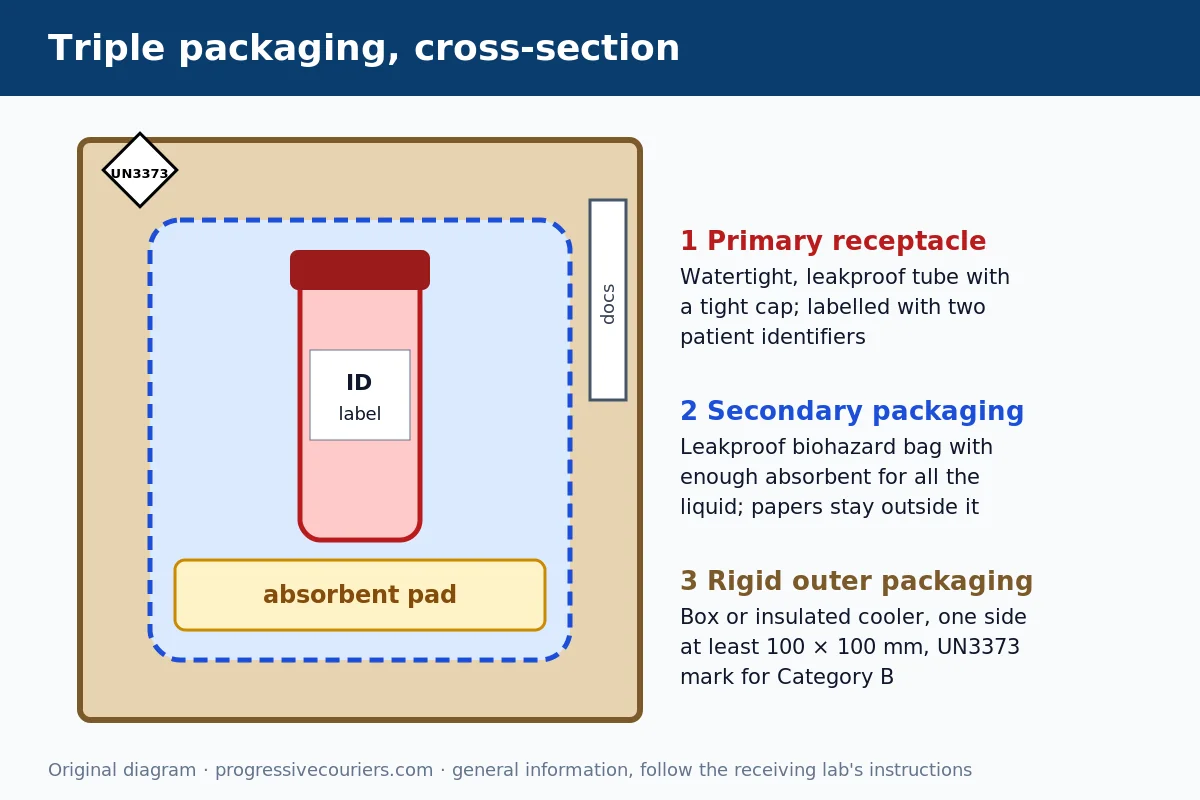
- Check the primary receptacle: the right tube for the test, cap fully closed, no cracks, outside wiped clean, and labelled with at least two patient identifiers.
- Wrap or separate tubes so glass or plastic cannot touch if several share one secondary package.
- Place enough absorbent material in the secondary packaging to absorb the full liquid volume of every primary receptacle.
- Seal the secondary packaging (zip, adhesive strip or screw-top canister). Do not put paperwork inside it.
- Put the requisition in the separate document pouch on the outside of the bag, or between the secondary and outer packaging.
- Add the itemized list of contents between the secondary and outer packaging for Category B shipments.
- Place the secondary packaging in a rigid outer box or cooler, with refrigerant or dry ice outside the secondary if the specimen needs it.
- Close the outer packaging and mark it: the UN3373 diamond with “Biological substance, Category B”, or “Exempt human specimen”, plus the responsible person’s name and phone number where required.
Sources: DOT (eCFR) — 49 CFR 173.199, Category B infectious substances · CDC — Packing Category A, B and Exempt Specimens job aid (PDF)
Requirements for each layer
Primary receptacle. It must be leakproof for liquids or siftproof for solids. For air transport, the primary or the secondary packaging must withstand an internal pressure differential of at least 95 kPa without leaking, which is why air-rated specimen bags carry a 95 kPa statement. No primary receptacle may hold more than 1 L of liquid when shipped by air.
Secondary packaging. It must be leakproof (or siftproof for solids). The absorbent must be able to absorb everything in the primary receptacles. Biohazard specimen bags usually have the biohazard symbol and a rear pocket for documents.
Outer packaging. It must be rigid and of adequate strength for its capacity, mass and intended use. At least one surface must have minimum dimensions of 100 mm × 100 mm, and the complete package must pass a 1.2 m drop test without leakage from the primary receptacle. For air, an outer package may contain no more than 4 L or 4 kg.
Sources: DOT (eCFR) — 49 CFR 173.199, Category B infectious substances · IATA — Dangerous Goods Regulations
Marks and labels on the outer package
Category B: the UN3373 marking in a square-on-point (diamond), with each side at least 50 mm long, and the words “Biological substance, Category B” next to it in letters at least 6 mm high. Exempt human specimens are marked “Exempt human specimen” and do not use the UN3373 mark. For air shipments, dry ice adds UN1845, the net weight and the Class 9 label.
Outside the facility, OSHA also requires a biohazard label or red color-coding on the specimen container or its secondary container unless the facility’s exemption applies, which ends once the specimen leaves the facility.
Sources: DOT (eCFR) — 49 CFR 173.199, Category B infectious substances · PHMSA — Transporting Infectious Substances Safely
Common triple-packaging mistakes
- Requisition sealed inside the bag with the tube, where a leak soaks it.
- No absorbent, or too little for the volume in the bag.
- Tubes loose against each other or against a gel pack.
- A soft mailer used as the outer packaging.
- Dry ice placed inside the sealed secondary bag or an airtight container.
- Wrong or missing marks: UN3373 on an exempt package, or no mark at all.
Frequently asked questions
- What are the three layers of triple packaging?
- A leakproof primary receptacle (the tube), a leakproof secondary package with absorbent (usually a biohazard specimen bag), and a rigid outer package such as a box or cooler.
- Does the absorbent go in the secondary bag?
- Yes. It sits between the primary receptacle and the secondary packaging and must be able to absorb the entire liquid contents.
- Is triple packaging required for exempt human specimens?
- Exempt specimens still need a leakproof primary, leakproof secondary and outer packaging of adequate strength with absorbent for liquids, marked “Exempt human specimen”. They do not need the UN3373 mark or the drop test.
- What does 95 kPa mean on a specimen bag?
- The bag or primary container can withstand a 95 kPa pressure differential without leaking. It is required for liquid specimens shipped by air.
Official sources
- CDC — Submit and Ship Specimens
- CDC — Packing Category A, B and Exempt Specimens job aid (PDF)
- OSHA — 29 CFR 1910.1030, Bloodborne Pathogens
- DOT (eCFR) — 49 CFR 173.199, Category B infectious substances
- DOT (eCFR) — 49 CFR 173.217, Carbon dioxide, solid (dry ice)
- PHMSA — Transporting Infectious Substances Safely
- IATA — Dangerous Goods Regulations
- WHO — Guidance on regulations for the transport of infectious substances
- eCFR — 42 CFR 493.1242, Specimen submission, handling, and referral (CLIA)
- HHS — The HIPAA Privacy Rule
Related guides
- Lab Specimen Transport Requirements
- Specimen Transport Temperature Ranges
- Specimen Chain of Custody During Transport
- Specimen Transport Supplies Checklist
- Specimen packaging & transport guide (by lab)
- Specimen packaging resources
- OSHA bloodborne pathogens & specimen transport
Medical couriers by city
Arizona: Phoenix · Mesa · Scottsdale · Tempe · Chandler · Gilbert · Glendale · OSHA-trained couriers in Phoenix
Austin, TX area: Austin · Round Rock · Cedar Park · Georgetown · Pflugerville · San Marcos · OSHA-trained couriers in Austin
Not medical, legal or regulatory advice. General information last reviewed 2026-11-01; regulations change, so read the current official text linked above and follow the receiving laboratory’s instructions. Progressive Couriers is an independent courier and is not affiliated with any laboratory or supplier named on this page. Illustrations are original diagrams.
Questions? 602-499-2672