Specimen Transport Temperature Ranges
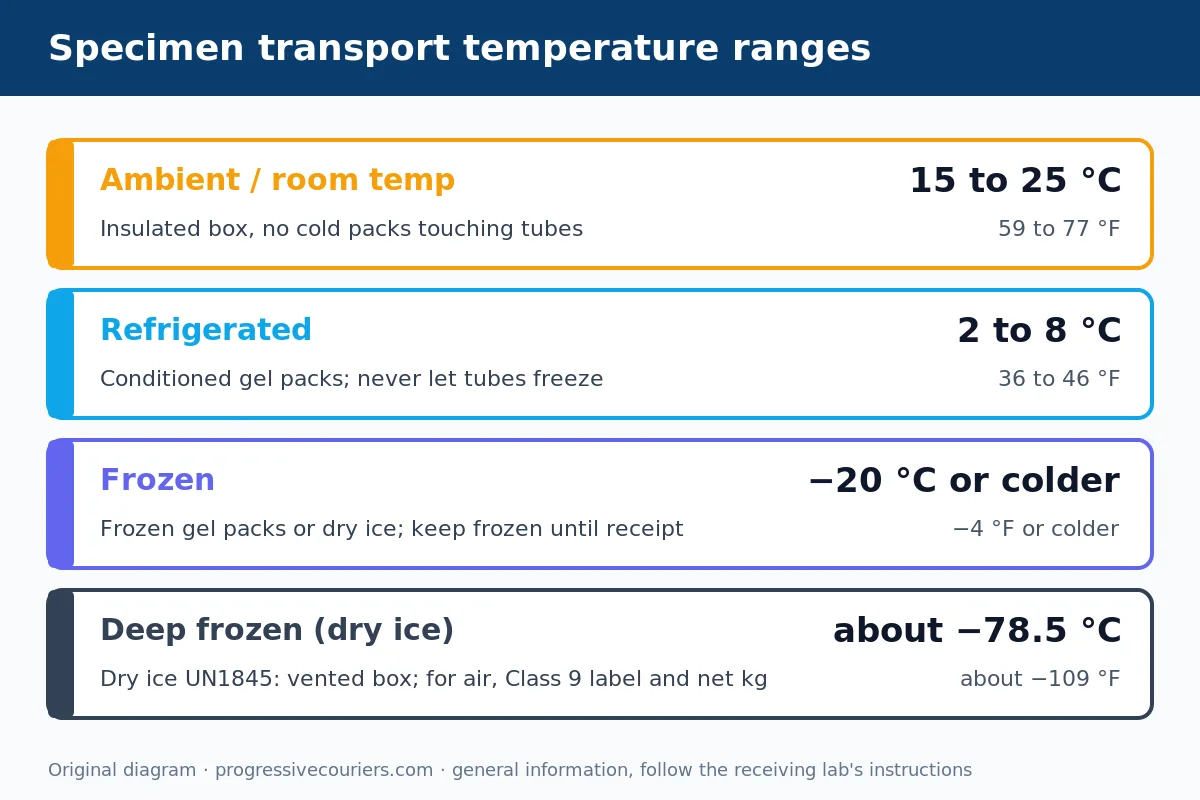
Lab specimens travel in one of three temperature bands set by the test: ambient at 15–25 °C, refrigerated at 2–8 °C with conditioned gel packs, or frozen at −20 °C or colder with frozen packs or dry ice. Dry ice (UN1845) must be allowed to vent carbon dioxide and is never sealed airtight.
Updated 2026-11-01
← Lab specimen transport requirements
The test sets the temperature
Each test in a laboratory’s directory lists a specimen type, a transport temperature and a stability time. A serum chemistry tube may be stable for days refrigerated, a whole-blood count may need to stay at room temperature, and some specimens must be frozen within an hour of collection. Use the lab’s instructions, not a general rule, when the two disagree. Under CLIA, the laboratory must have written instructions for specimen transport and handling and may reject specimens that do not meet them.
Sources: CDC — Submit and Ship Specimens · eCFR — 42 CFR 493.1242, Specimen submission, handling, and referral (CLIA)
Ambient (room temperature): 15–25 °C
Ambient means controlled room temperature, usually 15 to 25 °C (59 to 77 °F); some labs use 18 to 25 °C. In a hot vehicle or a cold one, an insulated box without cold packs helps keep ambient specimens in range. Do not put ambient specimens in a cooler with refrigerated gel packs. In summer heat, never leave a box in a parked vehicle or in direct sun.
Refrigerated: 2–8 °C with gel packs
- Condition gel packs in a refrigerator, not a freezer, unless the shipper is designed for frozen packs.
- Place a barrier (cardboard, bubble wrap or a divider) between the packs and the specimen bags so tubes cannot freeze.
- Put packs outside the secondary packaging, never inside the sealed bag.
- Use enough packs for the transit time and outside temperature, and close the cooler fully.
- Where the lab requires it, include a thermometer or data logger.
Frozen: −20 °C or colder
Frozen specimens must stay frozen from the freezer to the lab’s freezer. For short local runs, frozen gel packs in a well-insulated cooler can hold −20 °C; for longer runs or for specimens that must be held at −70 °C or colder, dry ice is used. A specimen that thaws and refreezes may be rejected, so transfer it quickly and do not open the cooler in transit.
Dry ice: venting, UN1845 and marking
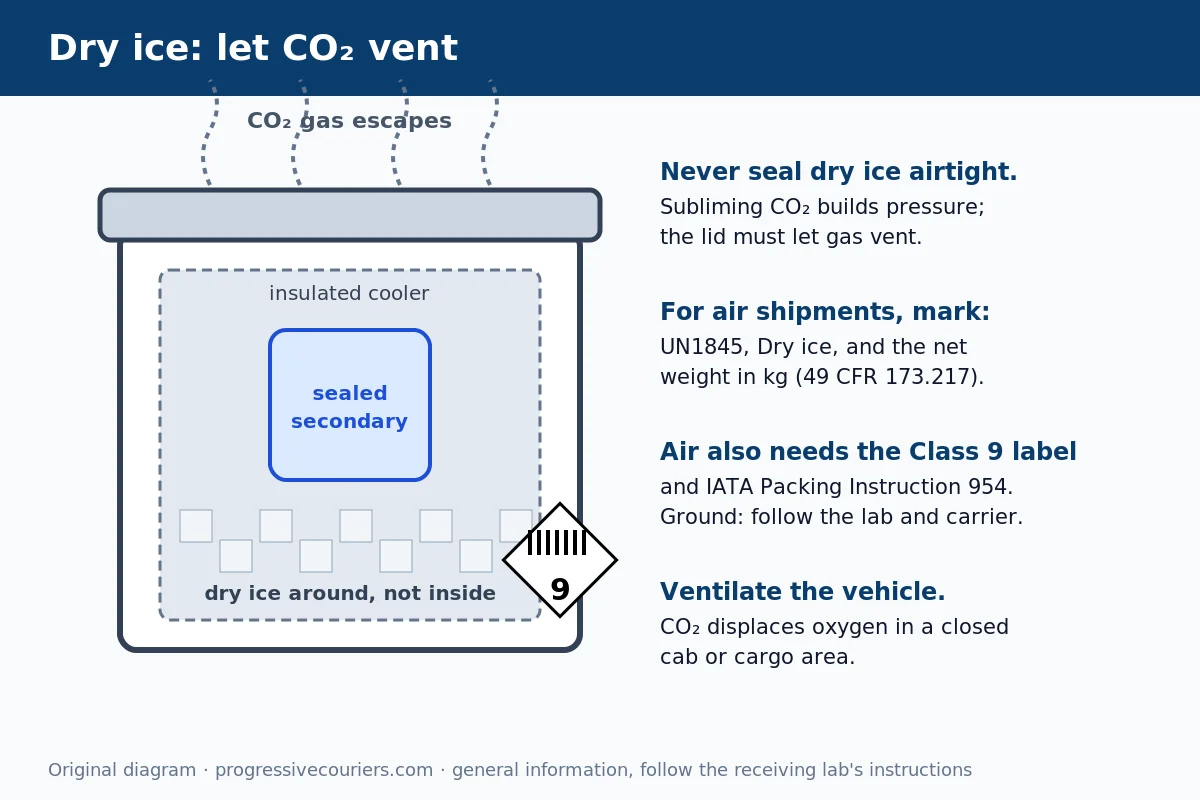
- Dry ice is solid carbon dioxide at about −78.5 °C (−109 °F). Handle it with insulated gloves.
- It must be allowed to vent. The packaging has to let CO₂ gas escape so pressure cannot build and rupture it. Never put dry ice in a sealed bag, an airtight container or the sealed secondary packaging.
- Place dry ice around the secondary packaging, inside an insulated outer package, with supports so the specimens stay in position as the ice sublimates.
- For air transport, mark the outer package “UN1845” and “Dry ice” or “Carbon dioxide, solid” with the net weight of dry ice in kilograms (49 CFR 173.217).
- Also for air, add the Class 9 miscellaneous hazard label and follow IATA Packing Instruction 954 and the operator’s limits. For local ground runs, venting is still required; follow the lab’s or carrier’s marking instructions.
- Ventilate the vehicle. CO₂ displaces oxygen and can build up in a closed cab or cargo area.
Sources: DOT (eCFR) — 49 CFR 173.217, Carbon dioxide, solid (dry ice) · IATA — Dangerous Goods Regulations · PHMSA — Transporting Infectious Substances Safely
If a temperature goes out of range
Record it. Note the time, the reading and how long the specimen was out of range, tell the sending facility and the lab, and let the lab decide whether the specimen is acceptable. Do not try to “fix” a warmed refrigerated specimen by freezing it, and do not let a thawed frozen specimen refreeze without telling the lab.
Temperature table
| Condition | Range | How it is held | Typical use |
|---|---|---|---|
| Ambient (room temperature) | 15–25 °C (59–77 °F) | Insulated box, no cold packs | Many whole-blood and routine specimens |
| Refrigerated | 2–8 °C (36–46 °F) | Refrigerator-conditioned gel packs with a barrier | Many serum, plasma and urine specimens |
| Frozen | −20 °C (−4 °F) or colder | Frozen gel packs or dry ice | Specimens the test directory lists as frozen |
| Deep frozen | −70 °C (−94 °F) or colder | Dry ice (UN1845) in a vented shipper | Specimens for special testing |
The receiving laboratory’s test directory sets the required range and stability time for each test.
Frequently asked questions
- What temperature is ambient for specimen transport?
- Usually 15–25 °C (59–77 °F), controlled room temperature. Some labs specify 18–25 °C.
- What temperature is refrigerated for specimens?
- 2–8 °C (36–46 °F), usually held with refrigerator-conditioned gel packs separated from the tubes so they do not freeze.
- What temperature is frozen for lab specimens?
- −20 °C (−4 °F) or colder. Specimens that need −70 °C or colder travel on dry ice.
- Why must dry ice vent?
- Dry ice sublimates into carbon dioxide gas. In a sealed container the pressure can build until the package bursts, and in a closed vehicle CO₂ displaces oxygen.
- What is UN1845?
- The UN number for carbon dioxide, solid (dry ice). For air shipments, packages are marked UN1845 with the net weight of dry ice in kg and carry the Class 9 label (49 CFR 173.217 and IATA).
Official sources
- CDC — Submit and Ship Specimens
- CDC — Packing Category A, B and Exempt Specimens job aid (PDF)
- OSHA — 29 CFR 1910.1030, Bloodborne Pathogens
- DOT (eCFR) — 49 CFR 173.199, Category B infectious substances
- DOT (eCFR) — 49 CFR 173.217, Carbon dioxide, solid (dry ice)
- PHMSA — Transporting Infectious Substances Safely
- IATA — Dangerous Goods Regulations
- WHO — Guidance on regulations for the transport of infectious substances
- eCFR — 42 CFR 493.1242, Specimen submission, handling, and referral (CLIA)
- HHS — The HIPAA Privacy Rule
Related guides
- Lab Specimen Transport Requirements
- Triple Packaging for Lab Specimens
- Specimen Chain of Custody During Transport
- Specimen Transport Supplies Checklist
- Specimen packaging & transport guide (by lab)
- Specimen packaging resources
- OSHA bloodborne pathogens & specimen transport
Medical couriers by city
Arizona: Phoenix · Mesa · Scottsdale · Tempe · Chandler · Gilbert · Glendale · OSHA-trained couriers in Phoenix
Austin, TX area: Austin · Round Rock · Cedar Park · Georgetown · Pflugerville · San Marcos · OSHA-trained couriers in Austin
Not medical, legal or regulatory advice. General information last reviewed 2026-11-01; regulations change, so read the current official text linked above and follow the receiving laboratory’s instructions. Progressive Couriers is an independent courier and is not affiliated with any laboratory or supplier named on this page. Illustrations are original diagrams.
Questions? 602-499-2672