OSHA Bloodborne-Pathogen Trained Medical Couriers in Red Rock, TX
Progressive Couriers provides OSHA bloodborne-pathogen trained medical couriers in Red Rock, TX. Our drivers handle lab specimens in sealed secondary containment, carry spill kits and gloves, keep a chain of custody on every order, and keep ambient, refrigerated and frozen items separate.
Specimen courier work in Red Rock
Red Rock is a rural community in southern Bastrop County along SH 21. Red Rock residents use couriers for medical items, documents, and parts from Bastrop, Lockhart, and Austin.
Specimen runs from Red Rock often start at or go to Ascension Seton Bastrop, St. David's Emergency Center – Bastrop and Ascension Seton Smithville. Our drivers pick up across SH 21 corridor, Red Rock community and rural Bastrop County. Red Rock is about 38 road miles from downtown Austin; runs into central Austin go east on SH 71 to Bastrop, then south on SH 21, or south on US 183 toward Lockhart.
What “OSHA bloodborne-pathogen trained” means for Red Rock pickups
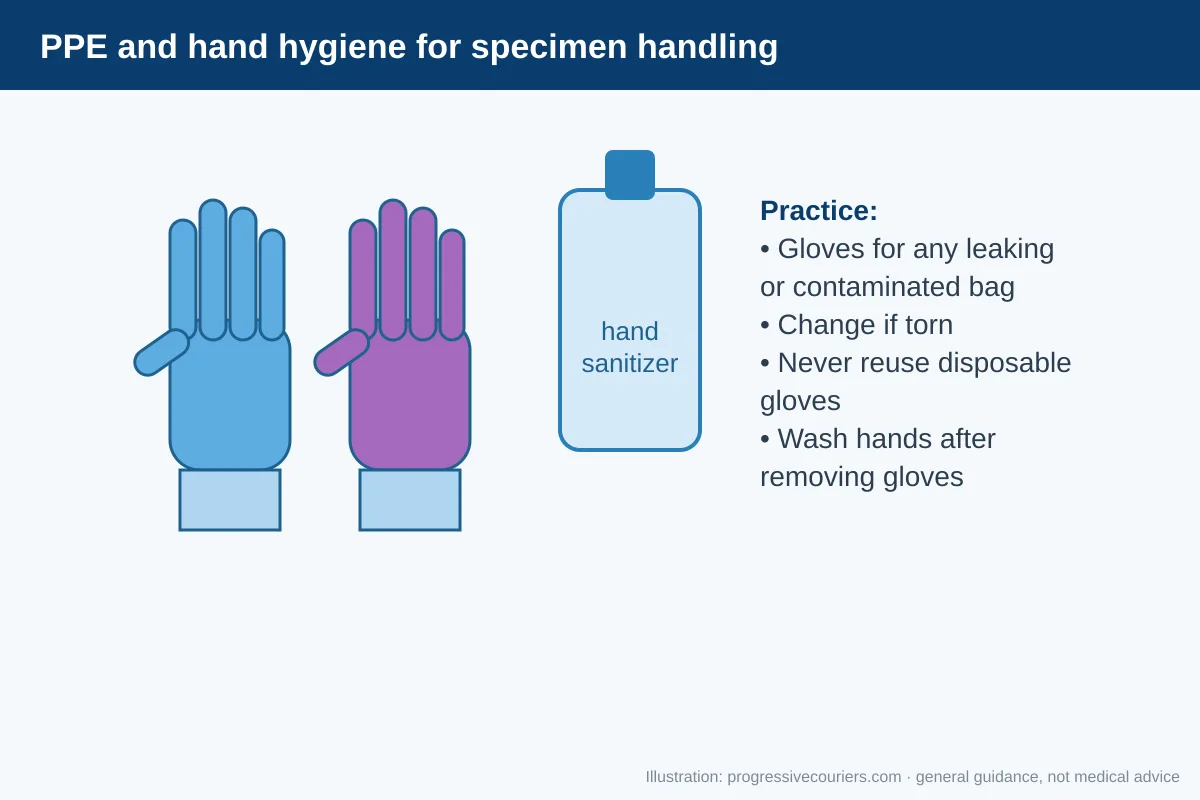
OSHA’s Bloodborne Pathogens Standard, 29 CFR 1910.1030, covers employees who could reasonably be expected to contact blood or other potentially infectious materials on the job. For a courier in Red Rock, that covers handling a bag that is leaking or soiled on the outside, or cleaning a cooler after a tube breaks. Our drivers are trained on universal precautions, glove use and hand hygiene, recognizing biohazard labels, and the steps to take after a spill or exposure.
We follow the same practice at a Red Rock lockbox as at a hospital loading dock. Every specimen is treated as potentially infectious, bags stay sealed, and anything contaminated on the outside goes into additional containment before it is moved.
Our process in Red Rock
Sealed secondary containment: we accept specimens sealed in leak-proof primary containers inside closed secondary bags with absorbent, and they stay in that containment from pickup to delivery.
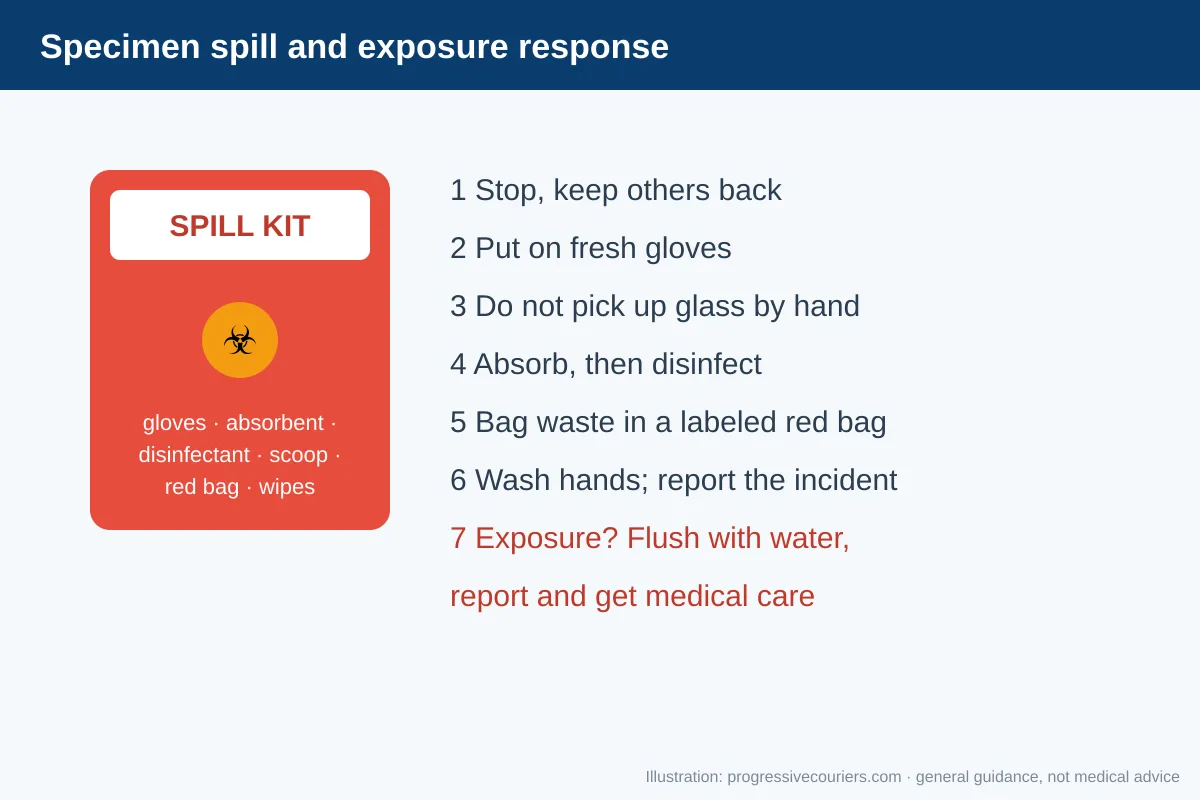
Spill kits: drivers carry gloves and a spill kit. If something leaks, they absorb and disinfect, bag the waste, keep paperwork clear, and report it to dispatch and the sending facility.
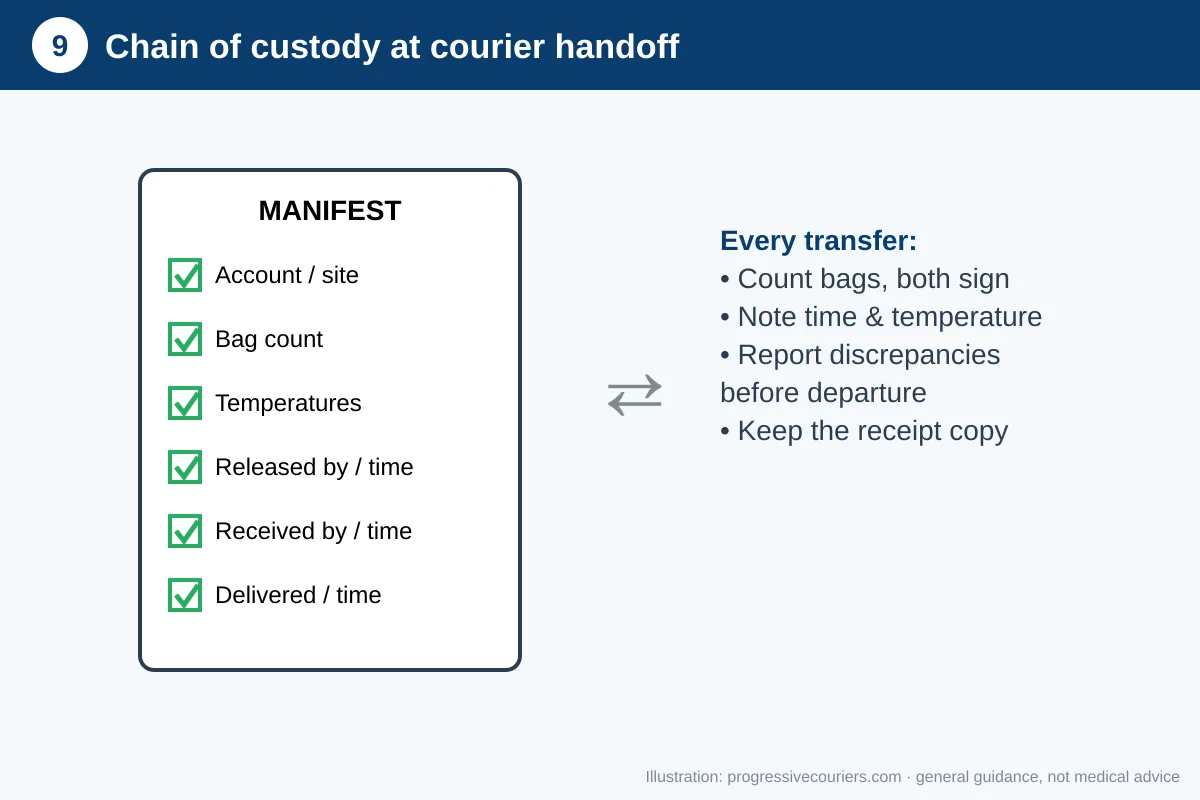
Delivery record: each order records the pickup time, the bag count, the driver, and the delivery time. Requisitions stay out of sight, and specimens are not left unattended in a vehicle.
Temperature control: ambient, refrigerated and frozen specimens travel in separate insulated containers. Tell us the requirement and the lab’s cutoff when you book.
Typical Red Rock specimen runs
A specimen bag from a Red Rock practice arrives at pickup with a damp outer surface. The driver gloves up, places it in additional containment, notifies the office, and records the discrepancy before departing.
A home health nurse in Red Rock needs a refrigerated draw moved to Ascension Seton Bastrop; it travels in its own insulated container, apart from ambient bags on the same run.
An after-hours lockbox pickup in Red Rock is logged with the bag count and time, so the receiving lab can match the manifest to what it receives.
Texas regulatory note
Red Rock is in Texas, which has no OSHA State Plan. Private-sector employers are under federal OSHA jurisdiction, and 29 CFR 1910.1030 applies directly.
Packaging for transport is separate. Clinical specimens are usually prepared by the sending facility as UN3373 Category B under 49 CFR 173.199 (triple packaging), and the receiving lab sets its own acceptance criteria under CLIA. We carry Category B and exempt specimens only, never Category A. See our OSHA & specimen transport guide for details and official sources.
Related pages for Red Rock
- Austin medical courier services
- STAT courier services in Red Rock
- Red Rock courier service
- Austin-area courier ZIP codes
- OSHA & specimen transport requirements guide
- Specimen packaging & transport guide
- Lab specimen transport requirements
OSHA-trained medical couriers nearby: Bastrop · Cedar Creek · Lockhart · Smithville
Frequently asked questions
- Are your Red Rock medical couriers OSHA bloodborne-pathogen trained?
- Yes. Drivers who handle specimens in Red Rock are OSHA bloodborne-pathogen trained, our handling is HIPAA-compliant, and Progressive Couriers is bonded and insured.
- What happens if a specimen leaks during a Red Rock pickup or delivery?
- The driver does not open the bag. They put on gloves, place it in additional containment, use the spill kit to clean any contaminated surface, keep paperwork away from the spill, and report it to dispatch and the sending facility.
- Which facilities do you run specimens to from Red Rock?
- Common destinations include Ascension Seton Bastrop, St. David's Emergency Center – Bastrop and Ascension Seton Smithville, along with reference labs, clinics and pharmacies across the Austin area. We are independent and not affiliated with any of them.
- Which Red Rock ZIP codes do you cover?
- We serve Red Rock ZIP codes including 78662. See our ZIP code page for the full list.
- Do you carry Category A infectious substances?
- No. We transport Category B (UN3373) and exempt clinical specimens only.
- Which OSHA program covers Texas employers?
- Texas has no OSHA State Plan, so private-sector employers are under federal OSHA, and 29 CFR 1910.1030 applies directly.
Official references: OSHA — 29 CFR 1910.1030, Bloodborne Pathogens · eCFR — 49 CFR 173.199, Category B infectious substances · OSHA — State Plans (Texas is under federal OSHA jurisdiction)
Progressive Couriers is an independent courier and is not affiliated with any hospital or laboratory named on this page.
Not legal, medical or regulatory advice. General information last reviewed 2026-10-31; regulations change, so read the current official text linked on this page and follow your employer’s exposure control plan and the receiving laboratory’s instructions. Illustrations are original diagrams for general education.
Questions? 602-499-2672