Commercial Move Planning Checklist for Arizona Businesses
A commercial move goes smoothly when you plan backward from the day you need to reopen: confirm both leases and building rules, name a move lead, inventory and label every item to a floor plan, book docks and elevators, have IT disconnect equipment, and move after hours in phases.
Book online any hour, track the truck live, and get a time-stamped record when the move is done. Bonded & insured, OSHA-trained, TSA cleared, serving since 2020.
Questions? 602-499-2672
- 24/7/365 dispatch
- HIPAA-compliant
- OSHA-trained drivers
- Bonded & insured
- TSA cleared
- Serving since 2020
What is the first step in planning a commercial move?
Set the reopen date and work backward. Write down the lease end at the old space, the access date at the new one, and the one weekend or evening window when the business can close. Everything else, from IT to furniture, is scheduled to fit that window.
Name one move lead with authority to make decisions, plus one contact at each building who knows the layout and can sign for the move.
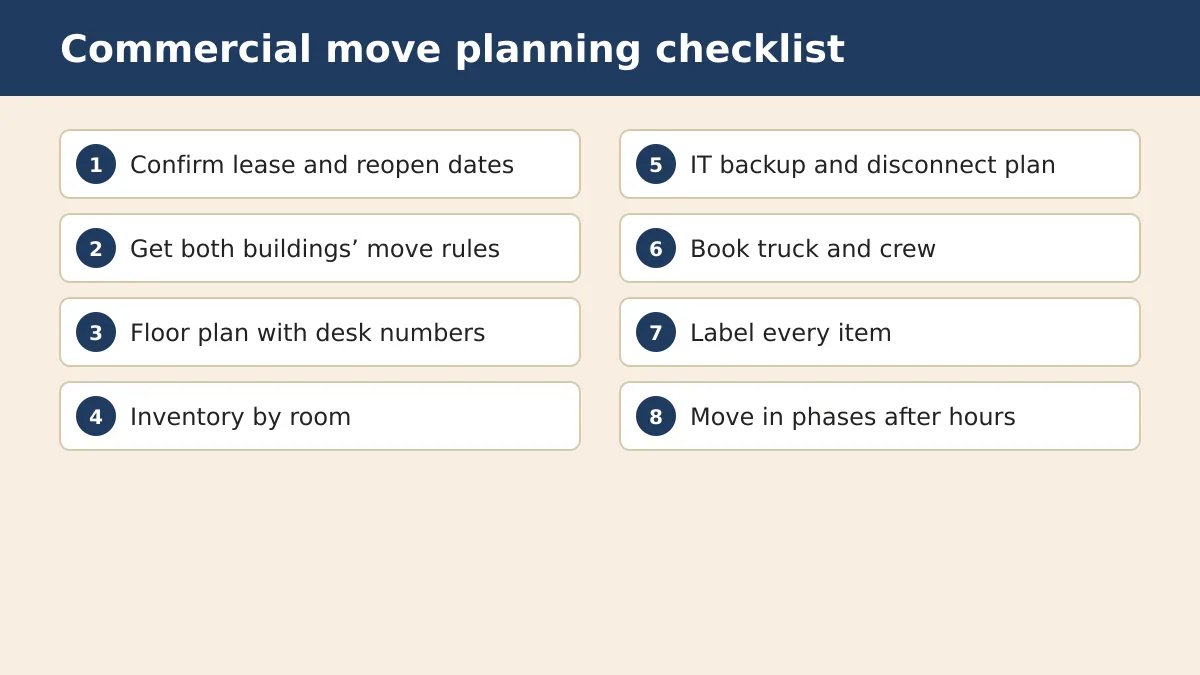
Commercial move checklist
- Confirm dates. Lease end, new-space access, building move hours and the reopen date.
- Get building rules. Ask both buildings for move-in rules, dock hours, elevator bookings and COI requirements.
- Measure the new space. Draw a floor plan and number every room, desk and workstation.
- Inventory. List furniture, equipment and file boxes by room.
- Decide what stays. Plan disposal, donation or sale of furniture that will not move.
- IT plan. Back up data, schedule disconnects, and plan network and phone service at the new site.
- Vendors. Book vendors for equipment that must be disconnected or reinstalled.
- Book the move. Book the truck and crew with both addresses, the window and the inventory.
- Label. Label every item with the new room and desk number.
- Notify. Update your address with customers, suppliers, banks and online listings.
- Move day. Have a move lead at each site; move archives first, then working desks.
- After the move. Walk the old space, test equipment and keep the delivery record.
How do you reduce downtime during a business move?
Move in phases. Storage rooms, archives and spare furniture go first, days ahead. Working desks and equipment move in one after-hours window. A final sweep picks up anything left behind. Labels that match the floor plan let the crew place items instead of stacking them.
Keep the phones and the website working: forward lines before the move and update hours and address listings the same day.
What should IT handle before movers arrive?
- Backups: Full backups of servers and workstations.
- Disconnect and label: Every cable bagged and labeled with its device.
- Pack: Monitors and peripherals boxed; racked equipment secured.
- New site ready: Network, power and phones live before move day.
Which businesses need extra planning?
Medical and dental offices need HIPAA-compliant handling of records and vendor preparation of clinical equipment; see medical office movers. Labs must decontaminate equipment and move samples separately; see lab equipment movers. Stores and restaurants move fixtures and stock overnight; see retail store movers. Schools and nonprofits often move during breaks.
How far in advance should you plan a commercial move?
Start 8 to 12 weeks ahead for a full office or practice. Book the moving crew 2 to 4 weeks before the window, once building dates are confirmed. A single suite can be planned in a week or two. Use the office move timeline for week-by-week tasks.
What does a moving crew need from you on move day?
A floor plan at each site, a contact who can answer questions, access to docks and elevators at the booked times, and items that are emptied, packed and labeled. Note anything over 300 pounds so the crew size is right. Book office movers or commercial moving when the plan is ready.
Frequently asked questions
- How long does a commercial move take?
- A small office often moves in one evening; larger offices are split into phases over several days.
- Who should lead an office move?
- One person with decision authority, supported by a contact at each building.
- Do movers disconnect computers?
- No. Your IT team should back up, disconnect and pack equipment; movers transport and place it.
- What is a COI?
- A certificate of insurance that many commercial buildings require from moving companies before move day.